Why most companies skip pre-commitment validation
July 3, 2026
•
8 min


This guide will teach you how to use your spend data to transform your business for profitable growth.

Download our free Low Risk Low Value (LVLR® ) framework to get complete spend visibility and achieve over 20% reduction in costs.

Download our Category Management Optimiser Checklist that has helped business leaders monitor and improve the effectiveness of their existing spend categories and subcategories enabling them to add millions to their bottom line.

Download our Transforming Finance With Artificial Intelligence (AI) Guide now and explore how AI can help you improve efficiency, build agility and make optimal strategic business decisions.
When does a deal actually start losing money? Not when finance flags it, but long before that. By the time the loss reaches a report, the damage is already done.
The way the margin leaves is quite unnoticed. Sales locks in a price, usually fixed. Procurement locks in a cost, usually indexed to something neither side controls, whether that’s freight, energy or currency. In the weeks between signing and delivery, the index moves, and the margin moves with it. Nobody modelled that shift, because no step in the process was ever made responsible for it. That space is the validation gap.
Pre-commitment validation simply puts the check back where it belongs, in front of the signature rather than behind it. It asks one question while you can still act on the answer: does this still make money under conditions you don’t control? The output is a decision you can act on — approve, block or escalate — and it’s logged.
Almost every control most businesses have faces backwards. Spend analytics tells you what you spent. Reporting tells you what happened. Both are useful, and both arrive too late to change the thing they’re describing.
Validating before you commit runs in the other direction. It sits in front of the signature and asks whether the deal holds up before you’re bound to it. That comes down to three questions. Is the deal viable on its own terms? Can the conditions it depends on actually hold? And will the result be traceable later, so the number you approved is the number you can defend?
None of that is complicated. It’s the check almost everyone assumes is already happening somewhere in the business. Trace it back, though, and most of the time you find it isn’t happening anywhere at all.
It would be easy to blame the analytics or the people, but it’s neither. The cause is timing and ownership.
Sales owns the price, procurement owns the cost, and finance owns the result. Each function does its job well, in sequence, and hands off to the next. The price is locked at one moment, the cost at another, and the result lands a quarter later. The space between those handoffs, which is where the margin actually lives, belongs to no one.
So that’s the part nobody is watching. The price is fixed while the cost is tied to an index, and from the day you sign to the day you deliver, that index drifts and takes the margin with it. It happens quietly, because no step was ever made responsible for noticing the drift.
By the time it surfaces, the decision that caused it is old news. You can’t renegotiate a contract you signed ninety days ago on terms the market has already moved past. The window to act closed the moment the ink went down, and nobody was standing at it.
No one plans for this gap. Most companies already have reporting, dashboards and monthly reviews. When a deal starts losing margin, finance can usually explain why.
What they rarely have is a step that asks the question before the deal is approved.
Each team does its own job. Sales wins the business. Procurement negotiates supplier costs. Finance reviews the numbers when they arrive.
The missing piece is a check that brings those views together before the commitment is made.
By the time the impact appears in a report, the contract has already been signed. The opportunity to renegotiate, change the terms or walk away has already passed.
So most businesses find margin problems after the event. The process was built to explain what happened. Catching it earlier needs a step before approval.
Closing the gap takes one extra question, asked at the point where the decision can still change.
Before a deal is approved, ask whether it still works if the assumptions behind it change. If supplier costs increase, freight moves or exchange rates shift, does the expected margin still hold?
If it holds, approve the deal. If it does not, you still have options: renegotiate, escalate, or walk away.
It is a small change, made at the one moment when you can still act on the answer.
Most organisations can explain why margin was lost after the fact. The bigger win is stopping the loss before it happens.
This takes one validation step before the commitment is made, while there is still time to act.
That is what Spendkey’s Commercial Control Layer does. It checks whether a deal still makes money before it is approved, and gives teams a clear decision: approve, block or renegotiate. Every decision is recorded, so there is a clear audit trail from approval to delivery.
Know the margin impact before you commit.
It’s checking whether a deal still makes money before it’s approved, rather than after it’s booked. It tests whether the deal is viable, whether its assumptions can still hold, and whether the outcome will be traceable. The result is a clear decision: approve, block or escalate.
Spend analytics looks back at what has already happened. Pre-commitment validation looks forward at a deal that hasn’t yet been approved, giving teams the opportunity to change the outcome before a commitment is made.
Because no single function owns the gap between commercial agreement and final approval. Sales, Procurement and Finance each own part of the process, but the validation step that brings everything together is often missing.
The validation gap is the space between agreeing a deal and approving it. During that time, costs, market conditions or other assumptions can change, but many organisations never check whether the deal still makes commercial sense before committing.
The ideal time is after the commercial terms have been agreed but before the final approval or signature. That’s the point where there’s still an opportunity to renegotiate, escalate concerns or decide not to proceed.
It shouldn’t sit with one function alone. Sales, Procurement and Finance each have part of the picture. Pre-commitment validation brings those perspectives together so decisions are based on a complete commercial view rather than individual assumptions.
It depends on why it failed. Some deals can still be approved, while others may need to be renegotiated, escalated for review or, in some cases, declined. The goal isn’t to stop deals — it’s to ensure they’ recommercially sound before a commitment is made.
No. It’s about understanding how resilient a deal is if conditions change. Rather than assuming supplier costs, freight,exchange rates or commodity prices will stay the same, it tests whether the deal still works if they don’t.


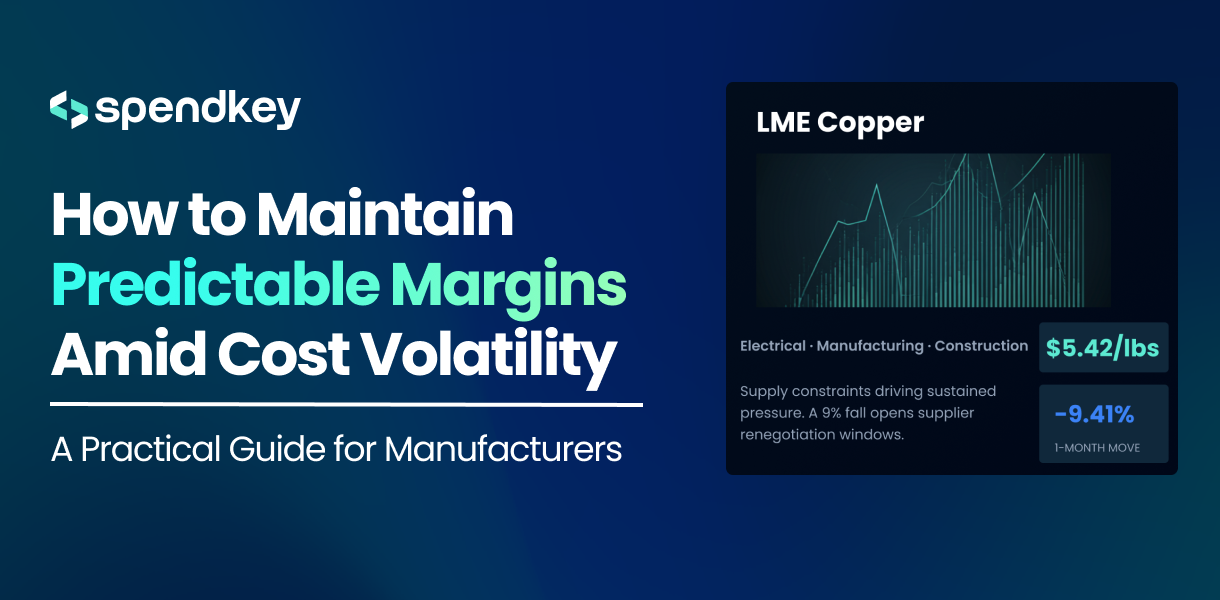
Commodity prices, freight costs, energy rates, and tariffs continue to move unpredictably. Discover why manufacturers can lose margin even when a deal looks profitable on day one, and how organisations are identifying margin risks before they impact the P&L.
CFOs and CPOs Finally Have What They’ve Always Wanted. Real answers. Real action. Real savings - in days. Explore how AI agents are changing the game.
Procurement teams don’t need more dashboards — they need direction. Discover how procurement teams are harnessing AI agents to accelerate decision-making, reduce risk, and hit savings goals faster.


Site by Strafe


