How to Maintain Predictable Margins Amid Cost Volatility: A Practical Guide for Manufacturers
June 19, 2026
•
6 min
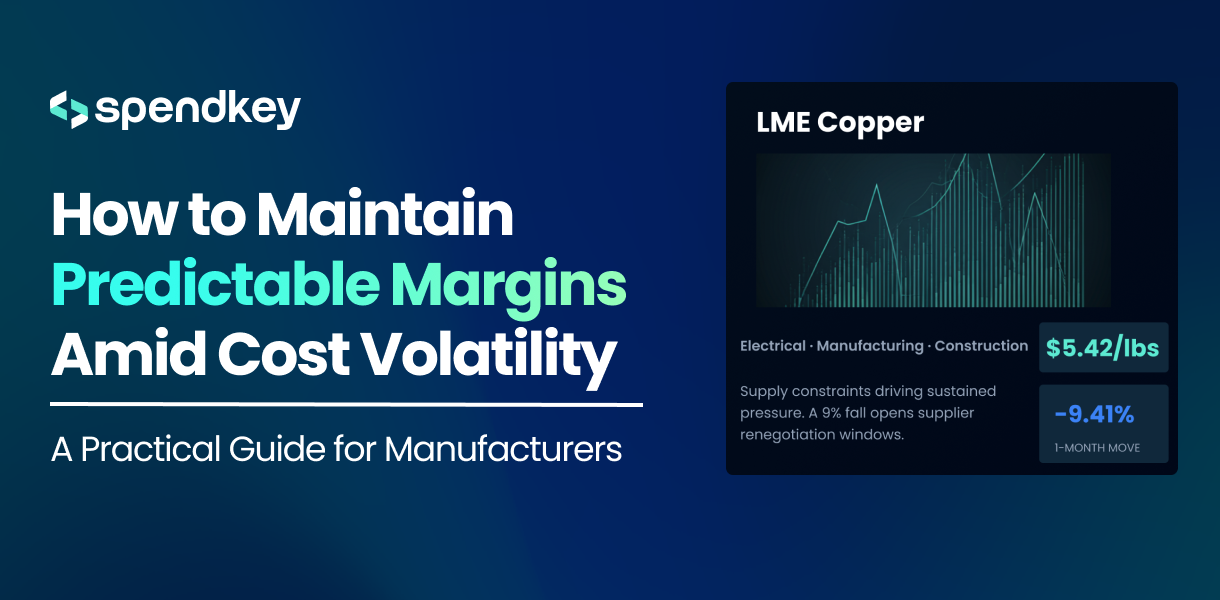

This guide will teach you how to use your spend data to transform your business for profitable growth.

Download our free Low Risk Low Value (LVLR® ) framework to get complete spend visibility and achieve over 20% reduction in costs.

Download our Category Management Optimiser Checklist that has helped business leaders monitor and improve the effectiveness of their existing spend categories and subcategories enabling them to add millions to their bottom line.

Download our Transforming Finance With Artificial Intelligence (AI) Guide now and explore how AI can help you improve efficiency, build agility and make optimal strategic business decisions.
Margin erosion is one of the most pressing challenges for manufacturers today.
Anyone involved in manufacturing over the past few years has seen how quickly costs can change. Raw material prices move unexpectedly, freight and energycosts fluctuate, and new tariffs can alter the economics of a deal almost overnight.
Most manufacturers have little control over these changes, yet they can have a significant impact on profitability. In these conditions, the challenge is not simply controlling costs.
It is understanding how those costs could change after a deal has been signed and what that means for the margin that was originally expected. And this is where many manufacturers struggle.
The issue is due to a structural problem. Sales, procurement, and finance teams each play a role in the profitability of a deal, but they are typically focused on different parts of the process.
In most manufacturing organisations, the sales team is responsible for winning the deal. They negotiate customer pricing, agree commercial terms, and often commit to fixed prices that may remain in place for several years.
Procurement teams work hard to secure the right suppliers at the right cost. But many of those costs continue to move after the contract has been signed. Commodity prices change, freight rates rise and fall, energy costs fluctuate, and suppliers often adjust pricing through index-linked agreements and surcharges.
Finance is responsible for profitability. But finance typically sees the impact after the fact through forecasts, management reports, or financial results, often weeks or months after the commercial commitments have already been made. This creates a gap.
On one side is a fixed customer price. On the other is a supplier cost base that continues to move. The space between the two is what we call the Margin Erosion Gap.
At the point a deal is signed, customer pricing and supplier costs may appear aligned. The challenge is that costs continue to move after the commitment has been made. By the time the impact becomes visible in forecasts or financial results, the margin is already lost.
Most manufacturers already have access to customer contracts, supplier agreements, pricing models, commodity indices, freight data, and financial forecasts.
The problem is that these pieces of information are rarely brought together when commercial decisions are made.
As costs become more volatile, organisations need a way to understand how changes in supplier costs, indices, freight rates, tariffs, and currencies could affect profitability before a deal is approved.
In other words, they need visibility into future margin. This is where Spendkey's Commercial Control Layer helps.
It gives sales, procurement, and finance teams a shared view of margin exposure, helping them identify risks, test different scenarios, and make better commercial decisions before margin erosion reaches the P&L.
Before a commercial commitment is made, the Commercial Control Layer connects customer pricing, supplier costs, contract terms, and market data, giving teams a clearer picture of how a deal is likely to perform.
It helps organisations understand how changes in costs could affect profitability over time. Rather than relying on a single margin assumption, teams can explore different scenarios and see how a deal performs if costs rise or fall after it has been signed.
The question it answers is simple: Does this deal still make money if costs move?
To answer that question, the Commercial Control Layer checks if the deal still makes money before it is approved. It compares:
Before a deal is approved, organisations gain visibility into:
Basedon the outcome, organisations can take one of three actions:
Instead of discovering margin erosion months later in the P&L, manufacturers can identify and act on margin risk before the commitment is locked in.
While cost volatility continues, the real challenge for manufacturers is understanding how those movements could affect profitability before commercial commitments are made.


Commodity prices, freight costs, energy rates, and tariffs continue to move unpredictably. Discover why manufacturers can lose margin even when a deal looks profitable on day one, and how organisations are identifying margin risks before they impact the P&L.
CFOs and CPOs Finally Have What They’ve Always Wanted. Real answers. Real action. Real savings - in days. Explore how AI agents are changing the game.
Procurement teams don’t need more dashboards — they need direction. Discover how procurement teams are harnessing AI agents to accelerate decision-making, reduce risk, and hit savings goals faster.


Site by Strafe


