Pricing against moving costs: why margin leaks between three rooms
August 6, 2026
•
8 min

This guide will teach you how to use your spend data to transform your business for profitable growth.

Download our free Low Risk Low Value (LVLR® ) framework to get complete spend visibility and achieve over 20% reduction in costs.

Download our Category Management Optimiser Checklist that has helped business leaders monitor and improve the effectiveness of their existing spend categories and subcategories enabling them to add millions to their bottom line.

Download our Transforming Finance With Artificial Intelligence (AI) Guide now and explore how AI can help you improve efficiency, build agility and make optimal strategic business decisions.
How do businesses protect margin when the price is fixed but the cost of delivering the deal keeps moving?
It looks like a pricing question. It is really a question of how three teams make one commercial decision.
Sales/Commercial agrees the customer price. Procurement agrees the supplier cost, or the terms that determine how it will move. Finance approves the expected margin.
Each team may have done its job. But if nobody checks those three decisions together before the contract is signed, the margin Finance approves may not be the margin the business eventually delivers.
That is where margin quietly leaks: not necessarily inside one department, but between three.
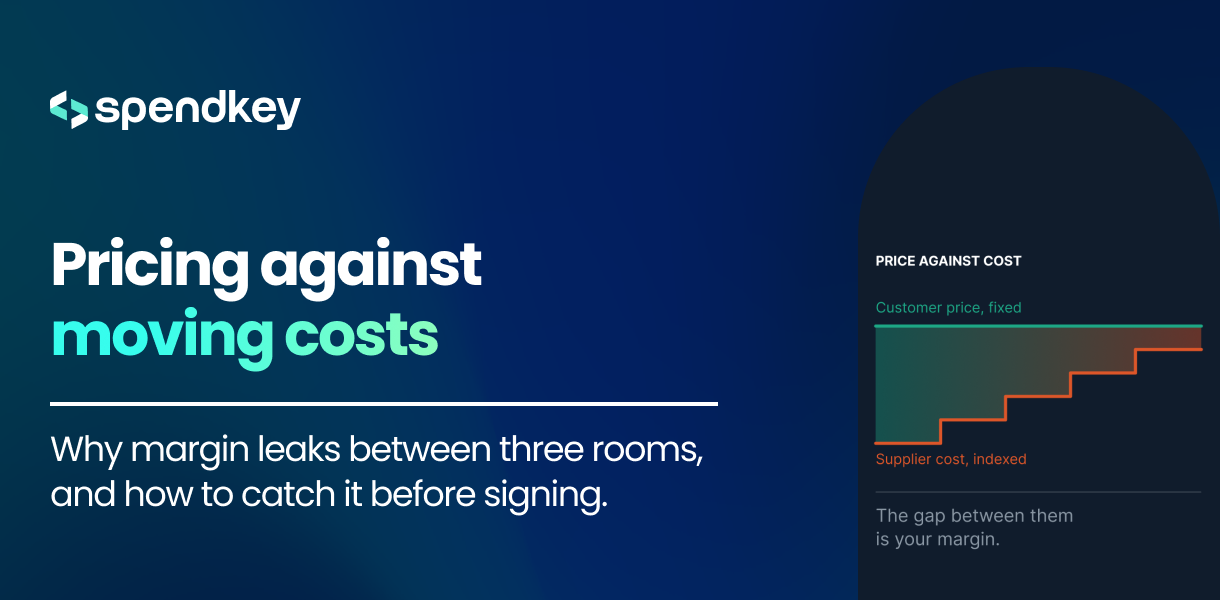
A customer price may be fixed or capped for months or years. The cost of delivering the deal can reset monthly, quarterly or whenever an index moves.
Steel moves. Energy moves. Freight moves. Exchange rates move. Labour costs change.
The customer price does not automatically move with them.
The commercial terms agreed at signing determine how much room the business has to respond. If those terms do not offer enough protection, Finance may only see the full impact later, when it appears in a forecast, management report or the P&L.
Finance can report the drop. It cannot undo the original commitment.
Three rooms, each holding one part of the answer.
Sales/Commercial agrees the customer price using the costs and assumptions available at the time.
But the price may remain fixed long after those assumptions have changed.
What Sales/Commercial may not have is a complete view of the supplier terms underneath the deal. It may not know what happens to the expected margin if steel, energy or freight rises by 5%, 10% or 15%.
The deal looks profitable based on the numbers in front of the team. But will it still be profitable when those numbers move?
Procurement agrees the supplier terms.
Some costs may be fixed. Others may reset monthly, quarterly or when a commodity, freight, labour or currency index moves.
But Procurement may not see the customer price Sales/Commercial has already committed to. And Sales/Commercial may not see how the supplier cost could change during the life of the deal.
Procurement prices what the business buys. Sales/Commercial prices what it sells.
Two numbers, two rooms, one margin caught in between.
Finance sees what happens when those two decisions meet.
If the customer price stays fixed while the supplier cost rises, the expected margin starts to narrow. But Finance may not see the full effect until the deal is already running.
By then, every option is a reaction.
The business can try to pass the increase to the customer and risk damaging the relationship. It can absorb the increase and accept a lower margin. Or it can go back to the supplier and try to renegotiate the cost.
Each option manages the problem after the commitment has been made. None of them checks whether the decision made financial sense before it was approved.
The problem is not necessarily poor pricing, weak procurement or inadequate financial reporting.
It is the gap between them.
The decisions that shape a deal’s margin are made by different teams, using different information and often at different points in the approval process.
Looking at any one decision on its own is not enough. The customer terms, supplier terms and expected margin need to be checked together before the business commits.
That check should answer one simple question:
Checking the deal before you sign
For every deal, the business needs to compare three things:
What if a major input cost rises by 5%, 10% or 15%?
What if the supplier price resets every month, but the customer price can only be reviewed once a year?
What if the customer contract caps price increases, but the supplier agreement does not?
These are not questions to ask after the deal reaches the P&L. They need to be answered while there is still time to change the terms.
Now everyone can see the same thing: the margin the business expects, what happens when costs move, and where the customer and supplier contracts fail to line up.
The decision-makers can then approve the deal, escalate it, renegotiate the terms or block it.
This is what Spendkey’s Commercial Control Layer is designed to do.
It sits above existing systems of record and checks the commercial logic at the point of approval, before the decision is locked in.
It reads both sides of the deal: the price promised to the customer and the costs agreed with suppliers. It also considers contracts, spend and relevant movements in commodities, freight, tariffs and foreign exchange.
It then shows what happens to the expected margin under different scenarios, with the evidence behind the result.
In one fixed-price contract review, Spendkey identified more than $13 million in potential exposure while there was still time to revisit the commercial terms.
This does not need to add another layer of meetings or slow the deal down.
It simply gives all three teams the same answer before anyone signs.
Sales/Commercial can price with a clearer understanding of the cost exposure. Procurement can see how its supplier terms affect the customer commitment. Finance can see how the expected margin changes before the impact reaches the P&L.
Margin stops being something the business only reports after the event.
It becomes something the business can control before it commits.
Customer price, supplier cost and expected margin cannot be checked separately. They need to be checked together, before the deal is approved.
That is the role of Spendkey’s Commercial Control Layer: to answer one question while there is still time to act.
Bring us one live deal. We will show you how the customer terms, supplier costs and market movements affect its future margin before it is approved.
Book a call with us here


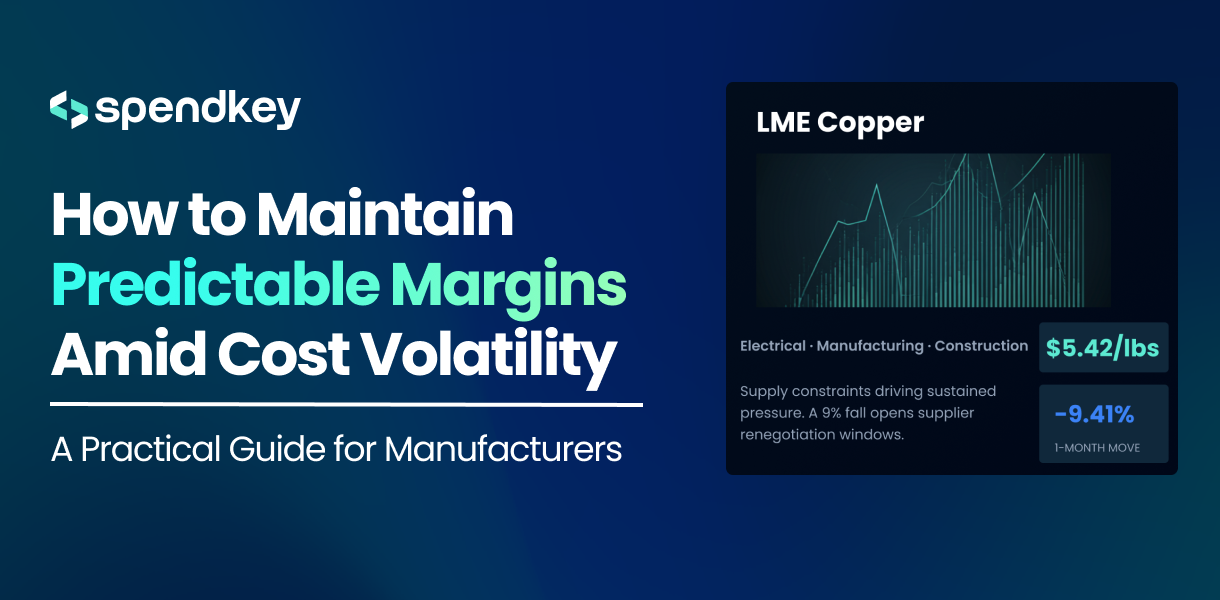
Commodity prices, freight costs, energy rates, and tariffs continue to move unpredictably. Discover why manufacturers can lose margin even when a deal looks profitable on day one, and how organisations are identifying margin risks before they impact the P&L.

CFOs and CPOs Finally Have What They’ve Always Wanted. Real answers. Real action. Real savings - in days. Explore how AI agents are changing the game.
Procurement teams don’t need more dashboards — they need direction. Discover how procurement teams are harnessing AI agents to accelerate decision-making, reduce risk, and hit savings goals faster.


Site by Strafe


