Blog
Pricing against moving costs: why margin leaks between three rooms
Sales/Commercial agrees the customer price. Procurement agrees the supplier cost, or the terms that determine how it will move. Finance approves the expected margin.
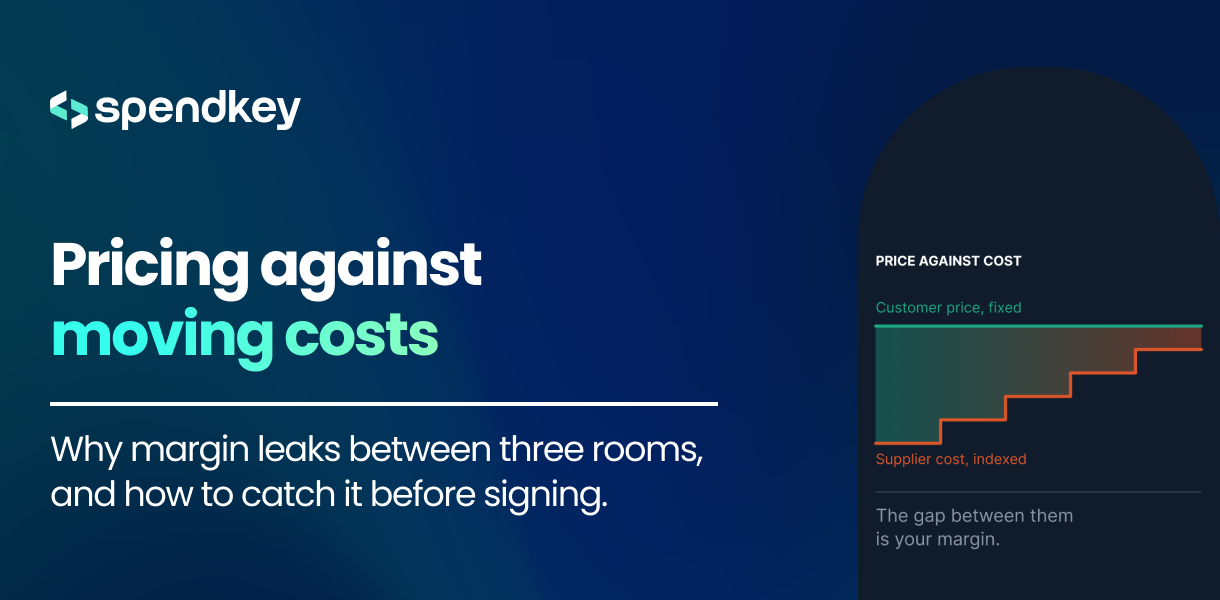
How do businesses protect margin when the price is fixed but the cost of delivering the deal keeps moving?
It looks like a pricing question. It is really a question of how three teams make one commercial decision.
Sales/Commercial agrees the customer price. Procurement agrees the supplier cost, or the terms that determine how it will move. Finance approves the expected margin.
Each team may have done its job. But if nobody checks those three decisions together before the contract is signed, the margin Finance approves may not be the margin the business eventually delivers.
That is where margin quietly leaks: not necessarily inside one department, but between three.
The gap between price and cost
A customer price may be fixed or capped for months or years. The cost of delivering the deal can reset monthly, quarterly or whenever an index moves.
Steel moves. Energy moves. Freight moves. Exchange rates move. Labour costs change.
The customer price does not automatically move with them.
The commercial terms agreed at signing determine how much room the business has to respond. If those terms do not offer enough protection, Finance may only see the full impact later, when it appears in a forecast, management report or the P&L.
Finance can report the drop. It cannot undo the original commitment.
Three rooms, each holding one part of the answer.
Room one: Sales/Commercial agrees the customer price
Sales/Commercial agrees the customer price using the costs and assumptions available at the time.
But the price may remain fixed long after those assumptions have changed.
What Sales/Commercial may not have is a complete view of the supplier terms underneath the deal. It may not know what happens to the expected margin if steel, energy or freight rises by 5%, 10% or 15%.
The deal looks profitable based on the numbers in front of the team. But will it still be profitable when those numbers move?
Room two: Procurement agrees how the cost will move
Procurement agrees the supplier terms.
Some costs may be fixed. Others may reset monthly, quarterly or when a commodity, freight, labour or currency index moves.
But Procurement may not see the customer price Sales/Commercial has already committed to. And Sales/Commercial may not see how the supplier cost could change during the life of the deal.
Procurement prices what the business buys. Sales/Commercial prices what it sells.
Two numbers, two rooms, one margin caught in between.
Room three: Finance sees the resulting margin
Finance sees what happens when those two decisions meet.
If the customer price stays fixed while the supplier cost rises, the expected margin starts to narrow. But Finance may not see the full effect until the deal is already running.
By then, every option is a reaction.
The business can try to pass the increase to the customer and risk damaging the relationship. It can absorb the increase and accept a lower margin. Or it can go back to the supplier and try to renegotiate the cost.
Each option manages the problem after the commitment has been made. None of them checks whether the decision made financial sense before it was approved.
Why this is a structural problem
The problem is not necessarily poor pricing, weak procurement or inadequate financial reporting.
It is the gap between them.
The decisions that shape a deal’s margin are made by different teams, using different information and often at different points in the approval process.
Looking at any one decision on its own is not enough. The customer terms, supplier terms and expected margin need to be checked together before the business commits.
That check should answer one simple question:
Does this deal still make money if its underlying costs move?
Checking the deal before you sign
For every deal, the business needs to compare three things:
- What the customer will pay
- What the deal will cost to deliver
- What happens to the margin when those costs move
What if a major input cost rises by 5%, 10% or 15%?
What if the supplier price resets every month, but the customer price can only be reviewed once a year?
What if the customer contract caps price increases, but the supplier agreement does not?
These are not questions to ask after the deal reaches the P&L. They need to be answered while there is still time to change the terms.
Now everyone can see the same thing: the margin the business expects, what happens when costs move, and where the customer and supplier contracts fail to line up.
The decision-makers can then approve the deal, escalate it, renegotiate the terms or block it.
Where the Commercial Control Layer fits
This is what Spendkey’s Commercial Control Layer is designed to do.
It sits above existing systems of record and checks the commercial logic at the point of approval, before the decision is locked in.
It reads both sides of the deal: the price promised to the customer and the costs agreed with suppliers. It also considers contracts, spend and relevant movements in commodities, freight, tariffs and foreign exchange.
It then shows what happens to the expected margin under different scenarios, with the evidence behind the result.
In one fixed-price contract review, Spendkey identified more than $13 million in potential exposure while there was still time to revisit the commercial terms.
What good looks like
This does not need to add another layer of meetings or slow the deal down.
It simply gives all three teams the same answer before anyone signs.
Sales/Commercial can price with a clearer understanding of the cost exposure. Procurement can see how its supplier terms affect the customer commitment. Finance can see how the expected margin changes before the impact reaches the P&L.
Margin stops being something the business only reports after the event.
It becomes something the business can control before it commits.
Customer price, supplier cost and expected margin cannot be checked separately. They need to be checked together, before the deal is approved.
That is the role of Spendkey’s Commercial Control Layer: to answer one question while there is still time to act.
Does this deal still make money?
Bring us one live deal. We will show you how the customer terms, supplier costs and market movements affect its future margin before it is approved.
Book a call with us here
Blog
Why most companies skip pre-commitment validation
A deal starts losing money long before finance flags it. Between signing and delivery, costs change, markets move and margins quietly erode because no one checks whether the deal still works. Here's why most companies validate after the fact, and how to move that check to before the signature.

When does a deal actually start losing money? Not when finance flags it, but long before that. By the time the loss reaches a report, the damage is already done.
The way the margin leaves is quite unnoticed. Sales locks in a price, usually fixed. Procurement locks in a cost, usually indexed to something neither side controls, whether that’s freight, energy or currency. In the weeks between signing and delivery, the index moves, and the margin moves with it. Nobody modelled that shift, because no step in the process was ever made responsible for it. That space is the validation gap.
Pre-commitment validation simply puts the check back where it belongs, in front of the signature rather than behind it. It asks one question while you can still act on the answer: does this still make money under conditions you don’t control? The output is a decision you can act on — approve, block or escalate — and it’s logged.
What it actually means
Almost every control most businesses have faces backwards. Spend analytics tells you what you spent. Reporting tells you what happened. Both are useful, and both arrive too late to change the thing they’re describing.
Validating before you commit runs in the other direction. It sits in front of the signature and asks whether the deal holds up before you’re bound to it. That comes down to three questions. Is the deal viable on its own terms? Can the conditions it depends on actually hold? And will the result be traceable later, so the number you approved is the number you can defend?
None of that is complicated. It’s the check almost everyone assumes is already happening somewhere in the business. Trace it back, though, and most of the time you find it isn’t happening anywhere at all.
Why the gap exists
It would be easy to blame the analytics or the people, but it’s neither. The cause is timing and ownership.
Sales owns the price, procurement owns the cost, and finance owns the result. Each function does its job well, in sequence, and hands off to the next. The price is locked at one moment, the cost at another, and the result lands a quarter later. The space between those handoffs, which is where the margin actually lives, belongs to no one.
So that’s the part nobody is watching. The price is fixed while the cost is tied to an index, and from the day you sign to the day you deliver, that index drifts and takes the margin with it. It happens quietly, because no step was ever made responsible for noticing the drift.
By the time it surfaces, the decision that caused it is old news. You can’t renegotiate a contract you signed ninety days ago on terms the market has already moved past. The window to act closed the moment the ink went down, and nobody was standing at it.
Why the check happens too late
No one plans for this gap. Most companies already have reporting, dashboards and monthly reviews. When a deal starts losing margin, finance can usually explain why.
What they rarely have is a step that asks the question before the deal is approved.
Each team does its own job. Sales wins the business. Procurement negotiates supplier costs. Finance reviews the numbers when they arrive.
The missing piece is a check that brings those views together before the commitment is made.
By the time the impact appears in a report, the contract has already been signed. The opportunity to renegotiate, change the terms or walk away has already passed.
So most businesses find margin problems after the event. The process was built to explain what happened. Catching it earlier needs a step before approval.
What changes when you validate first
Closing the gap takes one extra question, asked at the point where the decision can still change.
Before a deal is approved, ask whether it still works if the assumptions behind it change. If supplier costs increase, freight moves or exchange rates shift, does the expected margin still hold?
If it holds, approve the deal. If it does not, you still have options: renegotiate, escalate, or walk away.
It is a small change, made at the one moment when you can still act on the answer.
From reporting outcomes to preventing them
Most organisations can explain why margin was lost after the fact. The bigger win is stopping the loss before it happens.
This takes one validation step before the commitment is made, while there is still time to act.
That is what Spendkey’s Commercial Control Layer does. It checks whether a deal still makes money before it is approved, and gives teams a clear decision: approve, block or renegotiate. Every decision is recorded, so there is a clear audit trail from approval to delivery.
Know the margin impact before you commit.
FAQ
What is pre-commitment validation?
It’s checking whether a deal still makes money before it’s approved, rather than after it’s booked. It tests whether the deal is viable, whether its assumptions can still hold, and whether the outcome will be traceable. The result is a clear decision: approve, block or escalate.
How is it different from spend analytics?
Spend analytics looks back at what has already happened. Pre-commitment validation looks forward at a deal that hasn’t yet been approved, giving teams the opportunity to change the outcome before a commitment is made.
Why do so many companies validate only after signing?
Because no single function owns the gap between commercial agreement and final approval. Sales, Procurement and Finance each own part of the process, but the validation step that brings everything together is often missing.
What is the validation gap?
The validation gap is the space between agreeing a deal and approving it. During that time, costs, market conditions or other assumptions can change, but many organisations never check whether the deal still makes commercial sense before committing.
When should a deal be validated?
The ideal time is after the commercial terms have been agreed but before the final approval or signature. That’s the point where there’s still an opportunity to renegotiate, escalate concerns or decide not to proceed.
Who should be responsible for pre-commitment validation?
It shouldn’t sit with one function alone. Sales, Procurement and Finance each have part of the picture. Pre-commitment validation brings those perspectives together so decisions are based on a complete commercial view rather than individual assumptions.
What happens if a deal fails validation?
It depends on why it failed. Some deals can still be approved, while others may need to be renegotiated, escalated for review or, in some cases, declined. The goal isn’t to stop deals — it’s to ensure they’ recommercially sound before a commitment is made.
Is pre-commitment validation about predicting the future?
No. It’s about understanding how resilient a deal is if conditions change. Rather than assuming supplier costs, freight,exchange rates or commodity prices will stay the same, it tests whether the deal still works if they don’t.
Blog
How to Maintain Predictable Margins Amid Cost Volatility: A Practical Guide for Manufacturers
Commodity prices, freight costs, energy rates, and tariffs continue to move unpredictably. Discover why manufacturers can lose margin even when a deal looks profitable on day one, and how organisations are identifying margin risks before they impact the P&L.
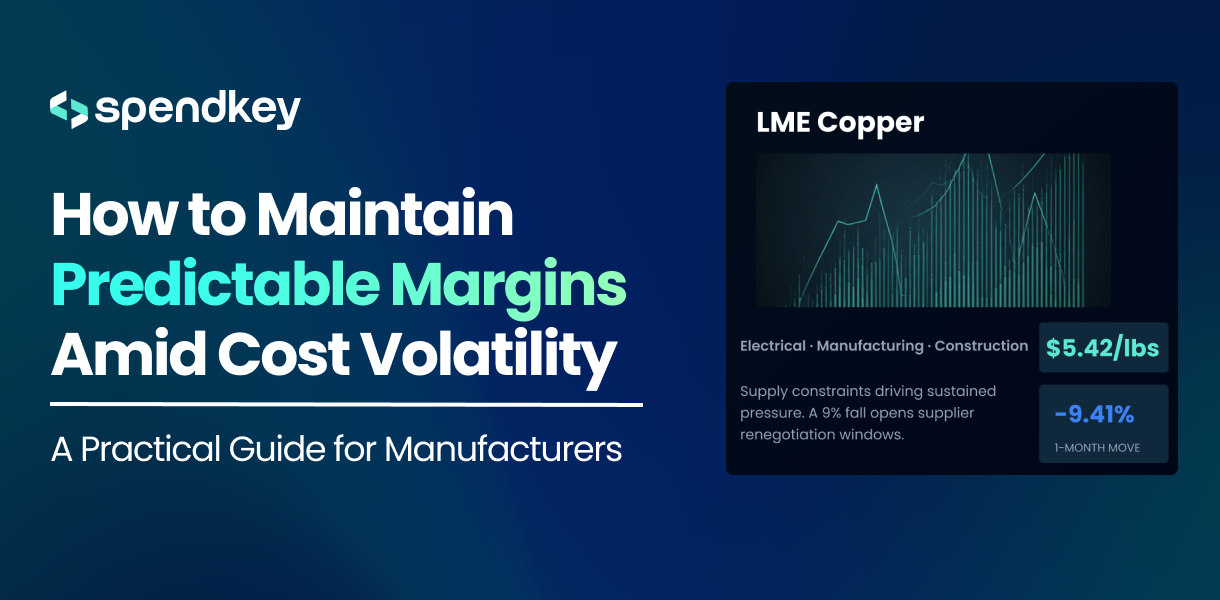
Margin erosion is one of the most pressing challenges for manufacturers today.
Anyone involved in manufacturing over the past few years has seen how quickly costs can change. Raw material prices move unexpectedly, freight and energycosts fluctuate, and new tariffs can alter the economics of a deal almost overnight.
Most manufacturers have little control over these changes, yet they can have a significant impact on profitability. In these conditions, the challenge is not simply controlling costs.
It is understanding how those costs could change after a deal has been signed and what that means for the margin that was originally expected. And this is where many manufacturers struggle.
The issue is due to a structural problem. Sales, procurement, and finance teams each play a role in the profitability of a deal, but they are typically focused on different parts of the process.
Three Teams – All Working in Isolation
In most manufacturing organisations, the sales team is responsible for winning the deal. They negotiate customer pricing, agree commercial terms, and often commit to fixed prices that may remain in place for several years.
Procurement teams work hard to secure the right suppliers at the right cost. But many of those costs continue to move after the contract has been signed. Commodity prices change, freight rates rise and fall, energy costs fluctuate, and suppliers often adjust pricing through index-linked agreements and surcharges.
Finance is responsible for profitability. But finance typically sees the impact after the fact through forecasts, management reports, or financial results, often weeks or months after the commercial commitments have already been made. This creates a gap.
On one side is a fixed customer price. On the other is a supplier cost base that continues to move. The space between the two is what we call the Margin Erosion Gap.
At the point a deal is signed, customer pricing and supplier costs may appear aligned. The challenge is that costs continue to move after the commitment has been made. By the time the impact becomes visible in forecasts or financial results, the margin is already lost.
How to Close the Margin Erosion Gap
Most manufacturers already have access to customer contracts, supplier agreements, pricing models, commodity indices, freight data, and financial forecasts.
The problem is that these pieces of information are rarely brought together when commercial decisions are made.
As costs become more volatile, organisations need a way to understand how changes in supplier costs, indices, freight rates, tariffs, and currencies could affect profitability before a deal is approved.
In other words, they need visibility into future margin. This is where Spendkey's Commercial Control Layer helps.
It gives sales, procurement, and finance teams a shared view of margin exposure, helping them identify risks, test different scenarios, and make better commercial decisions before margin erosion reaches the P&L.
How the Commercial Control Layer Works
Before a commercial commitment is made, the Commercial Control Layer connects customer pricing, supplier costs, contract terms, and market data, giving teams a clearer picture of how a deal is likely to perform.
It helps organisations understand how changes in costs could affect profitability over time. Rather than relying on a single margin assumption, teams can explore different scenarios and see how a deal performs if costs rise or fall after it has been signed.
The question it answers is simple: Does this deal still make money if costs move?
To answer that question, the Commercial Control Layer checks if the deal still makes money before it is approved. It compares:
- What cost the organisation is selling for
- What it will cost to deliver
- What happens over time if input costs move
Before a deal is approved, organisations gain visibility into:
- Expected margin
- Margin if costs move (e.g. +5%, -5%)
- Areas of contract misalignment
Basedon the outcome, organisations can take one of three actions:
- Approve– If the deal makes money
- Block – If the deal loses money
- Escalate– Escalated to the right authority if it seems risky
Instead of discovering margin erosion months later in the P&L, manufacturers can identify and act on margin risk before the commitment is locked in.
While cost volatility continues, the real challenge for manufacturers is understanding how those movements could affect profitability before commercial commitments are made.
Blog
From Data to Strategic Actions and Quick Outcomes: How AI Agents Are Empowering CPOs & CFOs
With AI agents, decisions and actions happen in hours, not weeks. They close the loop - turning insight into action, and action into quick, measurable outcomes.

The world of procurement is evolving faster than anyone expected.
The initial apprehension around AI is fading, and procurement teams are starting to see real, tangible value from AI and data-driven insights.
Yet, while AI and GenAI provide valuable insights, they often stop short of driving actionable results.
The result?
While AI provides insights most procurement teams are still unsure of the decisions and actions they need to take to achieve quick measurable outcomes. Most teams still struggle with the “insight-to-execution” gap. By the time a cost spike, contract risk, or supplier issue is identified, the damage is often already done.
This is where AI agents are rewriting the procurement and finance playbook.
What Are AI Agents and What Makes Them Different?
Unlike dashboards or static reports, AI agents don’t just show you what’s happening — they tell you what to do next and how to do it.
For CPOs and CFOs, whose top priority remains cost optimisation and business resilience, these agents are a game-changer.
What Makes AI Agents Different?
Here’s how they work:
Like AI and GenAI, agents rely on data. They transform fragmented data into a clean, structured, actionable dataset ready for deep analysis.
They continuously scan spend, supplier, and contract data in real time, flagging hidden risks and opportunities that often go unnoticed.
From spotting duplicate payments to surfacing expiring and non-compliant contracts, these agents catch issues before they become costly problems.
AI agents are goal-driven and continuously learn from your data, your behaviour, and your outcomes. They provide tailored recommendations on the best sourcing actions you need to take to achieve your goals - whether that’s supplier consolidation to reduce fragmentation and maximise leverage, launching an RFP for better competitive pricing, or initiating a negotiation to unlock savings or reduce risk.
And they don’t stop there. They deliver actionable playbooks. Agents don’t just recommend what to do; they provide the how, delivering step-by-step guides for your teams.
AI agents don’t just advise - they act. Wherever it makes sense, they initiate and automate actions that would otherwise take hours of manual effort.
For example, they can process thousands of invoices using smart data extraction, detect anomalies with 3- or 4-way matching, and flag overpayments or compliance issues early. This reduces risk and frees your team for high-value strategic work.
How Agents are changing the game for CPOs & CFOs: A New Kind of Visibility & Confidence
AI agents are giving CPOs and CFOs real strategic control. They empower leaders to make confident, fast decisions and take strategic actions that not only accelerate savings but also strengthen supplier relationships, reduce risk, improve working capital, and build lasting business resilience.
Unlike traditional tools that only provide static insights, AI agents combine automated recommendations with guided actions, enabling leaders to not only know what to do, but also how to do it. This shrinks the decision-making cycle dramatically, helping teams start implementing actions immediately and achieve quick, measurable value.
Real Impact: Faster Decisions, Faster Outcomes
Organisations using AI agents are seeing quicker, measurable results. Here are just a few examples from Spendkey AI agents in action:
- $9M in savings identified in 10 days
- Billions in spend classified with 97% accuracy in 10 days
- £60M in working capital freed by uncovering non-compliant payment terms
- 10,000+ utility bills processed with 98% accuracy for ESG reporting in under 50 hours
- 1.5%–3% spend optimisation through invoice anomaly detection
With AI agents, decisions and actions happen in hours, not weeks. They close the loop - turning insight into action, and action into quick, measurable outcomes.
Curious to see what our AI agents can do?
Email us at info@spendkey.co.uk
or book a demo today: https://calendly.com/spendkey/call
Blog
How AI Agents Are Transforming Spend Analysis in Procurement
We’ve helped procurement teams cut decision cycles by 5x and increase cost-efficiency 10x — unlocking millions in savings within days.

Procurement Teams Don’t Need More Dashboards. They Need Better Decisions.
Your procurement team is working hard, doing everything right — building dashboards, generating reports, and running regular spend reviews.
And yet, procurement costs are still rising — and savings targets remain out of reach.
You’re still trying to find answers::
- What do we act on today to actually hit our savings number?
- Which sourcing event will deliver the fastest ROI if we launch it now?
- Which category is driving the most spend — and is the cost justified?
- With which supplier in Marketing are we overspending — and is the cost justified?
Why?
Today procurement needs to move faster, operate smarter, and deliver more strategic value to business .
Traditional analytics and dashboards will give you static insights. But they don’t guide you on what to do next.
That’s where AI agents come in.
While dashboards give you insights, AI agents move beyond insights reshaping the way procurement teams make sourcing decisions.
What are AI agents in Procurement?
Think of AI agents as digital procurement co-pilots.
They work continuously analysing every transaction, document, contract, and supplier record across your procurement landscape. They understand your goals, connect the dots between your spend transactions, contracts, invoices, supplier insights and uncover hidden savings opportunities you didn’t even know existed.
They understand spend trends, flag anomalies— including overspend, supplier-related risks, contract expiries, and non-compliance — that often go unnoticed until it’s too late.
And they just don’t stop there.
They don’t merely show you insights or numbers — they go one step further, telling the clear story behind each spend. They recommend the next best sourcing action — whether that’s supplier consolidation, launching an RFP, or initiating a negotiation — so your team can take confident action with clarity and speed.
That’s where they differ from traditional spend analytics tools — they don’t just show you insights, they guide you to action.
How AI Agents Unlock Procurement Savings from Spend Data
AI agents combine automation, real-time analytics, and actionable recommendations — helping your team move from raw data to confident decisions, fast.
Here’s how they do it:
Data Transformation in Procurement
AI agents automatically clean, enrich, and unify procurement data from contracts, POs, invoices, and supplier systems — creating a single source of truth for analysis.
Automated Spend categorisation
AI agents categorise your spend into granular levels using standard, custom, or hybrid taxonomies — with high accuracy — so every line item is tracked and classified.
Real-time Procurement & Spend insights
AI agents map and connect multiple data sets — contracts, invoices, POs, supplier records, SOWs, MSAs — and continuously track spend patterns. They provide alerts on hidden risks, non-compliant spend, supplier anomalies, and contract expiries — enabling your team to act before these issues impact your bottom line.
Actionable Sourcing Recommendations
This is where AI agents go beyond traditional analytics. They not only show you the insights but clearly tell you what to do next.
They reveal hidden savings opportunities, pinpoint sourcing actions with the highest ROI — from supplier consolidation, contract renegotiations, payment term optimisation, RFP initiation and so on.
They guide your team step-by-step through every action — empowering you to go from insight to savings, fast.
Why Procurement Teams Are Turning to AI Agents
AI agents give you clear direction and deliver measurable impact real fast.
Here’s the strategic value they unlock:
Accelerate decision making and sourcing actions
AI agents shorten sourcing cycles from months to days by instantly analysing vast data sets and recommending the best course of action
Eliminate guesswork with data-backed recommendations
AI agents tell you exactly what to do, when, and why — with full transparency into the data and logic behind each recommendation.
Scale Procurement Intelligence
They monitor every supplier, every category, every transaction, every contact, invoice — continuously and autonomously giving you real time insights and recommendations
Proactive Risk Management
They spot risks and flag non-compliance, contract expiries, and cost anomalies in real time.
Can you trust the decisions AI Agents recommend?
Yes, you can trust AI agent recommendations — because every decision is based on your own procurement data.
Transparency
Every recommendation is backed by real data — not just what, but why. You’ll see the sources, the logic, and the assumptions behind every insight.
Explainability
You get a clear, human-readable narrative — something you can easily understand, question, and present to your board.
Auditability
Log every action, decision, and change. Be boardroom-ready with evidence behind decision.
Humans in the Loop
AI recommends decisions AI provides there commendations — but your team stays in control, reviewing every output before action is taken.
Ready to See AI Agents in Action?
Spendkey’s network of AI agents, Cassian, doesn’t just show you what’s happening — it guides you on what to do next. From cleaning your data to delivering real-time, ROI-focused recommendations, Spendkey helps you move faster, act smarter, reduce risk, and hit your savings goals with confidence. We’ve helped procurement teams cut decision cycles by 5x and increase cost-efficiency 10x — unlocking millions in savings within days.
Curious to see what our AI agents can do?
Email us at info@spendkey.co.uk
Or book a demo: https://calendly.com/spendkey/call
Blog
How Data-Driven Procurement Teams Win — Even With Smaller Teams
We help procurement teams automatically clean, unify, enrich, and categorise their spend, supplier, and contract data — powered by our AI platform and network of agents. Because once your data is right, every decision that follows becomes sharper, faster, and delivers greater impact.

Most procurement teams today share the same set of goals - cut costs, improve cash flow, reduce supply chain risks, manage contracts more efficiently, drive operational efficiency and agility, drive digital transformation and meet ESG targets - all while operating with leaner budgets and smaller teams.
It’s not easy for procurement teams to juggle all these priorities while operating with leaner budgets and small team.
So, here’s the critical question: Why are some organisations consistently hitting these priorities or confident to do so while others struggle, even when they have similar suppliers, budgets, and team sizes?
Any guesses?
Is it because they have better negotiation skills, more dashboards, bigger teams, or high-end technology investments?
Sure, those things can help but they are not the real enabler.
The real driver of procurement success is the quality of your data.
That’s what sets up your best negotiations, keeps costs in check, and makes supplier risks manageable.
Even the most sophisticated ERP systems or AI tools will fail to deliver true value if they’re running on messy, fragmented, or incomplete data.
Why data is the hidden force behind winning procurement teams
Most procurement teams don’t lack data. They are overwhelmed with data — scattered across multiple systems - ERPs, P2P platforms, spreadsheets, emails, and shared drives.
But this data is often unstructured, inconsistent, and incomplete.
Procurement teams typically use whatever data they can access, run analyses, and produce reports and dashboards that are meant to guide decisions.
And that’s where the real problems start. When decisions are made on bad data:
- You end up spending more than needed — hidden costs, duplicate invoices, missed rebates.
- You have too many suppliers providing the same product or service and no one even notices - depriving you of volume discounts.
- Contracts get signed and then forgotten, so rebates slip through the cracks.
- Tail spend grows unchecked, leading to revenue leakages.
- Poor visibility into supplier and contract data means increased risks and financial surprises.
- You’re providing incomplete or misleading insights to the C-suite, leading to sub-optimal procurement strategies that deliver little or no impact.
Meanwhile, the teams that have taken the time to lay their data foundation right have clear visibility and confidence in every decision and action they take.
Having unified and clean data sets helps teams gain accurate insights into their spend, contracts, and suppliers — and make more confident decisions and smarter moves. They can tap into rebate savings and align tighter payment terms with suppliers, improving working capital.
Clean data is the foundation for everything procurement wants to do next — whether it’s creating smarter category strategies, implementing AI solutions that uncover hidden savings or deploying autonomous AI agents that scan thousands of transactions and flag exactly what to fix, why it matters, and how to act.
So how can procurement fix data quality?
Data transformation isn’t easy — and it’s not as simple as it sounds.
It involves several critical steps that need to be followed to ensure that you have 100% good quality data.
It starts with data unification — consolidating all your data, whether it’s spend, supplier, or contract data, in one place.
The next step is data cleansing and enrichment - fixing duplicates, correcting inconsistent fields, mapping relationships like parent-child suppliers, and enriching your data with third-party sources.
Another key step before you even begin meaningful analysis is categorisation. It starts with grouping transactions into categories and subcategories, so you can clearly see where your spend is going. But it also extends to your suppliers and contracts, helping you build smarter strategies for each area, drive more savings, and keep risks under control.
Doing all this manually is slow, painful, and can be prone to mistakes.
Most procurement teams don’t have the resources to keep cleaning, mapping, and categorising thousands of records — and that’s why many are now turning to automated, AI-powered spend analytics solutions that start by getting the data right.
Once your data is clean, unified, and properly structured, it becomes your most valuable strategic asset.
That’s the real enabler behind why some procurement teams keep winning.
They’re building every negotiation strategy, sourcing plan, and supplier decision on a foundation of solid, trustworthy data.
Even the smartest AI solutions or the most advanced dashboards will fail to deliver real impact if they’re operating on bad data.
Ready to build your procurement strategy on a solid data foundation?
That’s exactly where we start at Spendkey — helping you unify, clean, and enrich your data so every decision is sharper, faster, and delivers more impact.
We help procurement teams automatically clean, unify, enrich, and categorise their spend, supplier, and contract data — powered by our AI platform and network of agents.
Because once your data is right, every decision that follows becomes sharper, faster, and delivers greater impact.
Blog
Unlocking Hidden Insights in Contracts: What You Need to Know
Discover Spendkey, an AI-powered spend decisioning tool that goes beyond analytics to provide insights and actionable strategies for achieving cost efficiency and reducing risk.

Businesses face significant revenue loss—averaging 9.2%—due to poor contract management. This number highlights the hidden costs of inefficient contract handling, leading to missed opportunities, compliance failures, and reduced profitability. Contracts contain vital information that can guide strategic decisions, yet many organizations struggle to access and leverage these insights effectively.
Traditionally, reviewing contracts meant reading through them line by line, an approach that was both labor-intensive and time-consuming. By the time teams extracted insights from numerous contracts, the information was often outdated or not actionable. To combat these issues, many businesses have adopted Contract Lifecycle Management (CLM) systems. However, challenges persist, such as overlooked contract renewals, limited visibility across contracts, and missed opportunities for better negotiations.
This is where advanced contract analytics steps in, bringing new efficiency and effectiveness to contract management.
What is Contract Analytics?
Contract analytics involves using technology to extract and analyse data from contracts, identifying key clauses, obligations, and risks. This approach provides timely and actionable insights, enabling organizations to make informed decisions.
Why Contract Analytics is Essential, even with a CLM System
1. Inconsistency and Lack of Organization
Managing thousands of contracts manually or through basic CLM systems often results in inconsistent and incomplete data. Without an advanced analytics tool, CLM systems may fail to create a unified repository that accurately reflects all contracts.
2. Limited Visibility
While CLM systems are effective for storing documents, they often fall short in offering a comprehensive, searchable overview. This can mean critical data is overlooked, leading to strategic blind spots and compliance challenges.
3. Time-Consuming Searches
Traditional CLM systems can require hours of manual searching to find specific clauses or key terms. This slows down decision-making and can cause missed opportunities for renegotiation or improved contract terms - opportunities that could save businesses millions.
4. Missed Deadlines and Renewals
Basic CLM systems may not provide automated alerts for contract milestones, resulting in missed renewals and lost revenue.
How Contract Analytics Addresses These Challenges
1. Handling Multiple Document Formats
Advanced contract analytics systems can process contracts in various formats, including PDFs and scanned images, identifying and extracting metadata to create a unified and standardised repository across the organization.
2. Real-Time Data Extraction
These systems analyse contracts quickly, identifying important clauses and extracting relevant data so that teams have immediate access to critical information and can make faster decisions.

3. Centralised Data Analysis
Integrating contract data from different sources allows organizations to analyse all relevant information in one place. This comprehensive view aids in maintaining consistency and ensuring that all contract details, obligations, and deadlines are accessible.
4. Automated Alerts for Renewals
Contract analytics solutions often come with built-in alerts for upcoming renewals and key contract dates. This helps teams stay proactive, avoiding missed deadlines and ensuring favourable contract negotiations.
Conclusion
Incorporating contract analytics into your contract management process offers numerous benefits. Automating data extraction, improving visibility, and gaining real-time insights help reduce risk and streamline workflows. Companies that integrate these advanced solutions can maintain consistency, avoid costly delays, and make better, data-driven decisions.
Spendkey’s contract analytics solution is designed to help organisations elevate their contract management strategy. Trusted by industry leaders, Spendkey automates analysis with unmatched accuracy and seamless integration.
Schedule a demo today to discover how Spendkey can transform your contract management approach and empower your team for success.
Blog
How to Quickly Cut Procurement Expenses: Harness the Power of Spend Analytics
Discover Spendkey, an AI-powered spend decisioning tool that goes beyond analytics to provide insights and actionable strategies for achieving cost efficiency and reducing risk.

Procurement is evolving, and its role as a value generator within businesses is more crucial than ever. For procurement leaders, balancing cost management with extending influence into strategic areas is no easy task, and the pressure to deliver is immense.
While procurement teams have made significant strides in meeting C-suite expectations across various domains, are they falling back in meeting C-suite expectations for cost management?
Is Procurement Failing the C-Suite?
Only 16% of C-suite executives have confidence in procurement's spend management.

Reducing procurement expenses has always continued to be among the top priorities for procurement teams and is crucial for maintaining profitability and gaining a strategic edge.
One of the most effective ways to achieve this is through spend analytics. By leveraging advanced data analysis techniques, companies can uncover hidden savings opportunities, optimise supplier relationships, and streamline procurement processes.
Understanding Spend Analytics
Spend analytics involves the collection, cleansing, enrichment, classification, and analysis of expenditure data to improve efficiency and reduce costs.
This process enables businesses to gain a comprehensive view of their spending patterns across various dimensions, uncover areas of high spend or revenue leakages, and identify areas where cost savings can be realised.
By transforming raw spend data into actionable insights, organisations can streamline processes, strengthen supplier relationships, and drive bottom-line growth.
Critical steps in Spend Analytics - It all starts with your data!
- Data Collection
Gathering data from various sources, such as invoices, purchase orders, and contracts, residing across different systems like ERP, HR systems, IT Asset databases, Product Catalogs, MS Excel, etc. - Data Cleansing
Ensuring data accuracy by removing duplicates and correcting errors. - Data Enrichment
Enrich the data by adding missing details and improving data quality to enhance the accuracy and depth of analysis. - Data Classification
Classify the data into relevant categories such as supplier, category, department, and geography using a standardised (e.g., UNSPSC, NAICS) or custom classification system to organise spending data for deeper analysis - Data Analysis
Analysing the spend data and delivering actionable insights. Quickly identify trends, patterns, and anomalies that indicate areas for cost reduction.
Benefits of Spend Analytics
- Enhanced Visibility and Control
It provides detailed insights into procurement transactions, allowing organisations to understand where their money is going and identify inefficiencies and areas for improvement. - Supplier Consolidation and Relationship Management
Provides visibility into the supplier landscape and performance. Consolidating suppliers enables better negotiation terms, leading to more favourable contracts, volume discounts, and improved supplier relationships. - Identifying Cost-Saving Opportunities
Highlights opportunities for cost reduction by providing granular insights into spend across various dimensions, including spend by suppliers, departments, location or categories, empowering you to identify areas of high spend, opportunities for consolidating suppliers, negotiations and cost savings. - Risk Mitigation
For see and mitigate risks associated with supplier dependency and compliance issues. - Budgeting and Forecasting
Get visibility into historical spend trends to enhance budgeting and forecasting accuracy. Predict future expenses and allocate resources more effectively. - Reduce Maverick Spend
Get visibility into non-contract spending and maintain budget control, ensuring procurement policies are adhered to and reducing unauthorised purchases.
AI-Powered Spend Analytics Solutions – The Game Changer
AI is transforming spend analytics from a reactive, manual process to a proactive, automated one.
- Mastering your Data
AI-powered tools are adept at mastering your data before delivering analysis and insights. These tools seamlessly integrate disparate, siloed data sources, automatically cleaning, classifying, and analysing your data to provide previously unattainable insights. - Automated Real-Time Analysis
AI continuously analyses and monitors your data, providing real-time insights and alerts for anomalies or deviations from the average spend trends or behaviours. - Tighter control of spend, with holistic spend, supplier and contract insights
AI-powered spend analytics solutions provide spend insights across various spend dimensions. In addition, these tools provide complete visibility into your supplier landscape and performance. Intelligent spend analytics solutions like Spendkey extend their capabilities to provide contract insights, offering you a unified solution that offers you spend, supplier and contracts insights all in one platform that facilitates better negotiations, improved strategic decision-making, reduced spend and improved compliance. - Predictive Analytics
AI spend Analytics solutions have predictive analytics capabilities that help you make future spend forecasts and enables you to streamline budgeting and forecasting. - Powered by Co-pilots or Assistants
Some Spend Analytics solutions have AI assistants that constantly analyse and understand your data and suggest optimal actionable strategies to achieve cost efficiency and reduce risks.
Best Practices for Implementing AI in Spend Analytics
Ready to start implementing AI-powered spend analytics solutions? Keep the following in mind.
- Start with Clean Data:
Effective AI relies on high-quality, consolidated data. Ensure your data is clean and accurate. - Define Clear Objectives:
Clearly understand your goals with AI, whether it's reducing costs, enhancing efficiency, or improving compliance. - Choose the Right AI Solution
Opt for AI tools that integrate well with your existing systems and can scale as needed. The tools should also be customisable to meet specific business requirements. - Monitor and Refine
Continuously monitor AI performance and refine algorithms based on feedback and evolving business needs.
Scouting for a AI Spend Analytics Solution?
Discover Spendkey, an AI-powered spend decisioning tool that goes beyond analytics to provide insights and actionable strategies for achieving cost efficiency and reducing risk.
Meet Cassian, Spendkey's AI Spend Co-pilot: Cassian collects, cleans, and enriches data from various documents and systems, analyses the data, shares insights, and provides actionable recommendations. With Cassian, you can take proactive steps to control spend, make timely decisions, and negotiate better deals. Automate tasks to reduce supply risk, cut costs, enhance quality, and improve sustainability and performance.
Cassian is launching soon! Would you like to be among the elite group of procurement leaders shaping Cassian to meet the industry's needs? Share your feedback and join the waitlist by clicking here.

Every month, Jessica, the CFO of a mid-sized tech firm, felt a sinking feeling in her stomach as she reviewed the company's financials. Expenses were soaring and getting way out of control. Her finance department was in chaos, with a team of finance professionals manually managing and reporting these expenses in spreadsheets and outdated systems.
She lacked confidence in the spend reports prepared by her team, which she had to present to the CEO each month. She was sure that maverick spending, duplicate invoices, and missed early payment discounts were just a few of the culprits draining her company's cash flow.
In meetings, when the CEO asked for real-time numbers and the reasons behind them, Jessica often fumbled. She didn't have the correct data at her fingertips and had to go back to her team to figure out the answers, further delaying the process and also undermining her credibility.
Jessica realised that it was high time to take action and was determined to find a better way to improve the efficiency of her team and the financial health of her organisation. Her quest for a solution led her to explore data analytics and artificial intelligence technologies. She had heard stories of companies leveraging these technologies to redefine their spend management practices.
Exploring Data Analytics
Jessica had heard about the benefits of data analytics and how data was proving to be the new oil. She had read about how data analytics was helping business leaders like her to:
- Gain Comprehensive Insights: By integrating data from various sources, analysing the data provided a holistic view of spending patterns, uncovering areas of inefficiency and opportunities for cost savings.
- Predict Future Trends: Historical data, when analysed correctly, revealed trends and enabled predicting future spending needs, aiding in budget planning and forecasting.
- Enhance Decision-Making: Detailed data analysis provided the insights needed to make informed decisions, from identifying savings opportunities to optimising resource allocation and strategic planning.
However, she was unsure of the in-house team's competency in getting the data right. She knew that they had plenty of data, but it was scattered across disparate systems and Excel spreadsheets. Besides, she was unsure of how clean her data was. She knew that manually consolidating, cleaning, and analysing the data was cumbersome. Jessica always relied on the numbers her team provided, but very often, they exceeded budgets, and forecasting was inaccurate.
That's when she decided to evaluate and implement an AI-powered spend analytics solution.
The Leap to AI-Powered Spend Management/ Spend Analytics
Jessica evaluated several AI-powered spend analytics solutions and was looking for a solution that could seamlessly integrate with her existing systems and required minimal intervention from her team. Key evaluation criteria that Jessica considered included:
- Seamless Integration: The solution needed to work with her current financial systems without requiring any significant changes.
- Minimal Team Intervention: The implementation process had to be straightforward, requiring only minimal intervention from her team.
- Automated Processes: The AI tools needed to have the capability of automating data management activities, including data consolidation, cleaning, and analysis, reducing manual effort and increasing accuracy.
- Real-Time Insights: The ability to provide up-to-date insights and actionable recommendations was crucial for timely decision-making.
Unbelievable Results
Jessica implemented the AI-powered spend analytics solution that best fit her requirements. She was astonished to see how this newly implemented AI-powered spend analytics solution delivered impressive results:
- Seamless Data Integration
The AI solution seamlessly integrated with the existing financial systems, automatically consolidating data from various sources in different languages and currencies. This integration helped create a single, reliable source of truth for all financial data. - Automated Data Management
With automated data consolidation, cleaning, and analysis capabilities provided by the spend analytics system, Jessica's team was freed from the tedious manual tasks of data analysis and reporting. - Real-Time Insights
One of the new system's most transformative aspects was its ability to provide real-time insights. Jessica could now access detailed reports and dashboards that offered a clear and real-time view of spending patterns, inefficiencies, and potential cost-saving opportunities. With accurate and real-time insights readily available at her fingertips, Jessica could make informed decisions quickly and confidently. - Improved Budgeting and Forecasting
The predictive analytics capabilities of the AI system enabled Jessica and her team to make spend forecasts. By analysing historical data and identifying trends, the system provided valuable insights that helped in budget planning and resource allocation. In addition, with real-time visibility on budget vs. actuals vs. forecasts and with built-in alert mechanisms, these systems empowered Jessica to take timely actions when actual spending overshot the budget. This system enabled Jessica and her team to achieve improved forecasting accuracy, reducing the risk of budget overruns and financial surprises. - Enhanced Decision-Making
With granular land real-time spend insights, Jessica was better equipped to make strategic decisions. She could identify areas where the company was overspending, negotiate better deals with suppliers, and optimise resource allocation to maximise value and present clear, data-backed recommendations to the CEO and the board to improve the company's financial health and growth strategies.
The impact of the AI-powered spend analytics solution on the company's financial health was evident. Within a few months, the company saw a significant reduction in unnecessary spend, streamlined their budgeting and forecasting process, and improved cash flow management. Early payment discounts were no longer missed, and maverick spending was brought under control. Jessica's finance team was now more efficient and productive, focusing on strategic tasks rather than manual data management. The enhanced visibility and control over spending allowed the company to get complete control over their spend, achieve faster savings, and improve the bottom line.
Jessica's story serves as a powerful example of how embracing technologies like data and AI can lead to quick, effective, and guaranteed improvements in financial health and organisational performance.
Blog
Pharma Finance Transformation: Unleashing AI for Cost Efficiency and Fiscal Excellence
Spendkey's AI-powered spend strategy solution leverages data, market intelligence and machine learning to convert raw data and documents into insights and actionable recommendations, empowering finance leaders to drive significant savings, improve budgeting and forecasting accuracy, improve working capital and make optimal business decisions to steer the organisation's financial strategy with confidence.

The global pharmaceutical industry continues to face a myriad of challenges. From battling rising inflation, soaring R&D costs, and supply chain disruptions to increasing competition compounded by regulatory changes and increased compliance costs, the unpredictable environment persists.
This unpredictable environment has brought about increasing pressure on finance leaders in the pharma industry, making it imperative for them to have clear visibility into every cost item on their P&L, stringent control over their spending, and effective cash and resource allocation strategies in place. Alongside, as seen in most industries, the role of finance leaders is also undergoing a paradigm shift, evolving from a finance leader into a strategic business advisor, driving strategic decisions to drive business growth. All this is leading to a transformative shift in the finance function with greater adoption of digitisation and automation and innovative technologies like data and analytics, artificial intelligence (AI), particularly GENAI.
GenAI in Finance
GenAI is reshaping every business function; the finance function is no exception.
Recent insights from a recent survey of finance leaders by research firm Gartner Inc. establishes this trend – 68% of finance leaders are using AI or plan to use the technology, according to a recent survey of finance leaders by Gartner, Inc.
Survey Question: In your finance function, which of the following best describes the current level of AI/ML?

The integration of GenAI in finance operations is becoming a tangible reality. GenAI is poised to reshape every facet of the finance function, be it financial planning, analysis, or execution, and bring about a fundamental shift in finance operations across businesses.

6 use Cases of GenAI for Finance leaders in the Pharma industry
1. Drive cost optimisation and uncover savings – Intelligent Spend Management
Driving cost efficiency has always been paramount and is among the top priorities for all finance leaders. AI-powered spend analytics solutions help finance leaders get real-time and granular insights into the organisation's spending patterns, identifying areas of unnecessary or excessive costs and opportunities for savings, thereby optimising overall spending. With clean data being the foundation for accurate analytics, these solutions have in-built data consolidation, cleansing, categorisation, and analytics capabilities, eliminating the tedious manual crunching process. These solutions help finance leaders track spending across various dimensions. No cost will go unnoticed, whether it's spending by department, cost categories, suppliers, or location.
2. Budgeting and Forecasting
Budgeting and Forecasting are two critical but complex functions. Traditionally, budgeting has been one of the most time-consuming and laborious activities for finance teams, demanding extensive hours and significant efforts to consolidate and get their underlying data right and understand historical trends to define future budgets and forecasts.
Also, gone are the days when an annual budget defined once a year served as the ultimate annual business goal. To define future-proof budgets and steer business growth, finance leaders need to have real-time visibility into the budget vs spend vs rolling forecast until the end of the financial year picture at all times to take timely decisions and actions. This is where AI-powered solutions can help. These solutions automate data consolidation and cleansing and provide a real-time comparison of spend vs budget vs forecast. These solutions also provide proactive alerts when spending crosses the defined budget thresholds. This visibility is invaluable as it empowers finance leaders to maintain fiscal discipline and ensure expenditures stay within planned limits.
These solutions can quickly analyse large volumes of financial data, provide predictive and prescriptive insights, and perform what-if scenario analyses, empowering financial leaders to make accurate financial projections, optimise cash flow, and redirect resources strategically.
3. Making informed decisions& taking quick actions
Making the right financial decisions is critical for organisations; hence, many of the best finance leaders make decisions based on empirical evidence rather than intuition. Advanced AI-powered solutions empower finance leaders to process large amounts of data into granular multi-dimensional insights. But that's not all - these solutions can provide predictive insights, market intelligence and actionable recommendations, thereby empowering finance leaders to make relevant and effective decisions. What's more - you can ask a question and get the answer straight from your data.
4. Risk Reduction
Integrating AI solutions in financial management gives finance leaders visibility into historical trends and patterns. They can analyse large datasets and reveal unnoticed fraudulent or suspicious transactions. These solutions are equipped with what-if scenario modelling, enabling finance leaders to proactively identify potential risks and fraud and take proactive actions to mitigate financial losses. In addition, these AI solutions enable finance leaders to ensure the accuracy and integrity of financial transactions, especially in their accounts payable processes. With 3-way or4-way matching capabilities, these AI solutions quickly compare the details in the purchase order, the goods received goods note, and the supplier's invoice and contracts, thereby preventing overpayments, duplicate payments, and fraudulent transactions.
5. Improved Efficiency and Reporting
In many organisations, finance leaders often grapple with the challenges of working with a lean team and are constantly under pressure to deliver timely and accurate reports to the CEO and the Board with confidence.AI technologies help automate many manual tasks like data consolidation and analytics, enabling finance leaders to present real-time spending reports to the CEO and the Board at any time and be 'Boardroom ready' at all times. Automation of routine tasks also helps free up the team from the manual number crunching activity to focus on more strategic activities.
6. Managing Contracts and Documents
Using AI-powered document or contract analytics solutions helps automatically extract key contract clauses, obligations, and financial details from contracts and documents, ensuring accurate financial reporting and increased compliance. These solutions also provide alerts for contract renewals, expirations, and spending irregularities, thereby empowering optimal decision-making and timely action.
GenAI is set to revolutionise the realm of finance function in the pharma industry. While some finance leaders have already integrated this within their function, many still need to learn about its potential and ROI. This is where solution providers like Spendkey can help.
Spendkey's AI-powered spend strategy solution leverages data, market intelligence and machine learning to convert raw data and documents into insights and actionable recommendations, empowering finance leaders to drive significant savings, improve budgeting and forecasting accuracy, improve working capital and make optimal business decisions to steer the organisation's financial strategy with confidence.
One of Spendkey's success stories involves helping a pharmaceutical company realise £25M in savings through AI-powered spend analysis. To gain insights into the benefits delivered, read the complete case study here
Blog
From Challenges to Triumph: How Emily Collins Transformed Procurement at Veritas Pharmaceuticals
Emily's journey of turning procurement costs into savings set a new standard within the pharmaceutical industry. Her strategic decision to embrace automated spend analytics had not only boosted Veritas's financial health but also inspired a paradigm shift in how businesses approached procurement.

Once upon a time, in the bustling heart of the pharmaceutical industry, there stood a prestigious company named Veritas Pharmaceuticals. Veritas has long been a leading player in the healthcare sector, known for its commitment to innovation and excellence. However, despite their success, the company's procurement costs had been steadily increasing, causing concern among its executives.
Amidst the challenges, Veritas appointed a new procurement leader, Emily Collins. Emily was a visionary with a fresh perspective and a profound understanding of data analytics. She knew that the key to unlocking potential savings lay within the vast sea of procurement data that Veritas had amassed over the years. Armed with a clear vision, Emily set forth on a mission to transform procurement costs into savings using the power of spend analytics.
The Revelation
Emily understood that to make a significant impact on procurement costs, she needed to unravel the mysteries hidden within the data. As she contemplated how to proceed, she faced a crucial decision: whether to build an in-house analytics team or leverage automated spend analytics platforms that could provide granular insights.
The allure of an in-house team was enticing, as it promised complete control over the analytics process. Emily knew that her team members would have an intimate understanding of the company's unique challenges and objectives. However, she also acknowledged that building and training a skilled data analytics team would take time and resources, delaying the potential benefits of spend analytics.
On the other hand, automated spend analytics platforms intrigued Emily with their promise of cutting-edge technology and speedy implementation. These platforms claimed to process vast amounts of data rapidly and quickly generate actionable insights. Emily knew these insights would go beyond what conventional ERP systems could offer, providing a deeper understanding of spending patterns and cost-saving opportunities.

The Power of Insights
Emily's contemplation led her to choose an automated spend analytics platform. With the platform' simple mentation, she quickly discovered that it provided a wealth of information previously hidden in the data. The platform's advanced algorithms unearthed patterns of maverick spending, supplier discrepancies, and regional variations that had gone unnoticed.
With these insights at her disposal, Emily could make data-driven decisions that targeted the root causes of escalating procurement costs. Her team could identify opportunities for strategic sourcing, consolidate suppliers, and negotiate better terms. The granular insights also highlighted potential areas for cost-cutting, such as optimising inventory levels and rationalising purchasing processes.
Supplier Optimisation: Strengthening Relationships for Better Results
Emily's data-driven approach to procurement extended beyond cost-cutting, allowing her to optimise supplier management. Armed with the powerful insights from the automated spend analytics platform, she gained a crystal-clear view of Veritas's supplier landscape.
By analysing the data, Emily could easily identify how many suppliers served each category. Armed with this information, she meticulously assessed each supplier's performance, contract, and pricing details. This deep analysis enabled her to distinguish high-performing suppliers from underperforming ones.
With a data-backed understanding of supplier performance, Emily set forth on a mission to optimise the supplier base. She streamlined and consolidated the supplier pool by removing underperforming and redundant vendors. This strategic approach simplified procurement operations and allowed for better resource allocation and enhanced supplier relationships.
As Emily narrowed down the supplier base, she could allocate more business to critical partners, which led to increased leverage during negotiations. Armed with precise spend data, she approached suppliers with confidence, demonstrating Veritas's commitment to data-backed decision-making. The strategic negotiations resulted in more favourable contracts and pricing terms for Veritas, driving further cost savings.
The optimised supplier base also enabled Emily to forge deeper and more collaborative relationships with key partners. As Veritas concentrated its business with fewer suppliers, they became more integral to each other's success. This level of partnership fostered greater trust and mutual commitment, leading to improved service levels, on-time deliveries, and a more robust support system.
Supplier optimisation not only bolstered Veritas's financial position but also enhanced the overall efficiency of its procurement operations. The streamlined supplier base and improved relationships enabled Veritas to respond more adeptly to market dynamics and swiftly adapt to changing demands.
The Magic of Data Visualization
One of the most potent aspects of spend analytics was its ability to present data visually appealing and easy to understand. Emily and her team developed interactive dashboards using the automated spend analytics platform that provided real-time updates on spending patterns and procurement performance.
These dashboards were shared across different departments, enabling them to monitor their spending and identify areas for improvement. With this newfound transparency, even the budget owners became actively involved in cost-saving initiatives.
Budgeting and Actual Spend Tracking
As Emily's team continued to analyse the data, they realised that the power of automated spend analytics extended beyond cost-cutting. One of the most valuable benefits they discovered was the ability to track actual spend at granular levels.
By leveraging the capabilities of the platform, Veritas could gain real-time visibility into its procurement spending. They could break down expenses by categories, departments, projects, and suppliers, enabling them to understand precisely where their financial resources were allocated.
This newfound transparency allowed for data-driven budgeting with greater accuracy and efficiency. Veritas could now allocate budgets based on actual spending patterns and adjust as needed throughout the fiscal year. This data-backed approach ensured that financial resources were directed to the areas that needed them the most, leading to better cost control and strategic decision-making.
With the power of actual spend tracking, Emily's team could identify potential cost-saving opportunities in real time. If any department exceeded its allocated budget, it could intervene promptly, investigate the root causes, and implement corrective measures. On the other hand, departments with underspent budgets could real locate resources to other strategic initiatives.
The ability to track actual spend at such a detailed level transformed Veritas's financial planning and control. They were no longer limited to historical financial reports but had access to up-to-date data that enabled proactive and agile budget management.
A New Era of Savings
As the months passed, Veritas Pharmaceuticals witnessed a remarkable transformation. Emily's unwavering commitment to spend analytics through the automated platform significantly reduced procurement costs, translating into substantial savings for the company.
With a newfound sense of financial prudence, Veritas reinvested the savings into cutting-edge research and development projects. The company's reputation soared as it launched breakthrough medications that transformed lives across the globe.
Emily's journey of turning procurement costs into savings set a new standard within the pharmaceutical industry. Her strategic decision to embrace automated spend analytics had not only boosted Veritas's financial health but also inspired a paradigm shift in how businesses approached procurement.

Ultimately, Veritas Pharmaceuticals emerged as a beacon of hope and innovation in the ever-evolving world of healthcare – a testament to the power of visionary leadership, the magic of automated spend analytics, and the art of making crucial decisions that shape the future. And so, the tale of Emily Collins, the transformative procurement leader, was a shining example of how data-driven leadership and automated insights could lead to unparalleled financial growth and industry-wide recognition.
Blog
Finance Leaders: A New Approach to Cost Control and Fastest Growth
Finance leaders need a new approach to cost control and growth, one that is focused on data-driven insights delivering tangible benefits.

In today's fast-paced business environment, companies are under increasing pressure to control costs and optimise revenue, all while ensuring that they remain competitive. Finance leaders play a crucial role in this, as they are responsible for managing the financial performance of their organisations. However, traditional cost-cutting methods, such as across-the-board budget cuts and staff layoffs, can be short-sighted and ultimately detrimental to a company's growth prospects.

So, what's the solution? A new approach to cost control and growth, one that is focused on data-driven decision-making and continuous improvement. This approach is not only more effective in achieving cost savings but also sets the company in the direction of sustainable growth.
One of the key components of this new approach is spend analytics. Spend analytics is a powerful tool that provides finance leaders with real-time visibility and control over their spend. By integrating data from across company's various financial systems and extracting actionable insights from that data, spend analytics can help finance leaders to identify opportunities for cost savings.
One of the key benefits of spend analytics is that it allows finance leaders to gain a more complete and accurate picture of their spending patterns. This can help them to identify patterns and trends that would be difficult to spot using traditional budgeting methods, and make data-driven decisions about where to cut costs. By using spend analytics, finance leaders can ensure that their cost-saving efforts are targeted at the areas of highest impact, rather than taking a blanket approach or guesstimate that either be ineffective or detrimental for the company.
But cost control is not the only thing that spend analytics can help finance leaders achieve. By identifying areas of high spend, finance leaders can also identify areas where they can make investments to drive growth. By allocating resources to the areas of highest potential return on investment (ROI),companies can achieve faster growth. Spend analytics provides the company with a holistic view of the spending patterns and areas of opportunity. This helps companies to focus on the right areas and make data-driven investment decisions.
Spend analytics can also help to improve the overall efficiency and effectiveness of financial management processes. By automating many of the tedious, manual tasks involved in spend management, such as data entry and reconciliation, spend analytics can free up finance leaders and their teams to focus on more strategic tasks. This can lead to faster, more accurate decision-making and amore efficient use of the company's resources.
But the benefits of spend analytics don’t stop there. The ability to track budget and forecast variances can help companies to identify potential financial risks and take corrective action before they become a problem. This improves the overall financial performance of the company.
The ability to automate many of the tedious, manual tasks, also helps to improve overall spend governance. This means that all spend is tracked, recorded, and reported accurately and that compliance and regulatory requirements are met. This helps to avoid any potential financial risks and legal complications.
In conclusion, finance leaders need a new approach to cost control and growth, one that is focused on data-driven insights delivering tangible benefits.
Blog
Budgeting and Forecasting with Spend Analytics: How Finance Leaders Can Achieve Greater Accuracy
With Spend Analytics, finance leaders can achieve greater accuracy in their budgeting and forecasting processes, which can lead to improved financial performance for their organisations.

One of the most important tasks for finance leaders is to define accurate budgets and make accurate financial forecasts. However, this is often easier said than done. Traditional budgeting methods rely on historical data and human judgement, which can lead to inaccuracies and missed opportunities.
But by using spend analytics, finance leaders can gain a more complete and accurate picture of their spending patterns, which can help them to create more accurate budgets and forecasts.
Spend analytics is a powerful tool that allows finance leaders to gather, analyse, and visualise data from their financial systems. By integrating data from multiple sources, spend analytics provides finance leaders with a unified view of their spend, which can help them identify patterns and trends that would be difficult to spot using traditional budgeting methods.
One of the key benefits of spend analytics is that it allows finance leaders to identify areas of high spend, which can help them to make more informed decisions about where to cut costs. For example, if a finance leader discovers that a particular department has significantly higher spend than budgeted, they can use spend analytics to drill down into the data and identify the specific vendors, expenses, or purchase orders causing the variance. This allows them to target their cost-saving efforts more effectively and make better-informed decisions about where to allocate resources.
Another vital benefit of spend analytics is that it allows finance leaders to get real time spend and compare it with their budget. By monitoring actual spend against budgeted amounts, finance leaders can identify areas of overspending and take corrective action to stay within budget and maximise earnings. This allows them to keep their finger on the pulse of the budget performance and make proactive adjustments as needed.
According to a report by the Association for Financial Professionals, 52% of companies surveyed cited budgeting and forecasting as the area where they would like to see the most improvement in their financial management processes. Spend analytics can be used to analyse historical data and identify patterns and trends, which can help finance leaders make more accurate predictions about forecast and budget variances. By understanding which areas are most likely to see increased or decreased future spending, finance leaders can make better-informed decisions about budgeting and forecasting. Furthermore, by automating spend management tasks, spend analytics can free up finance leaders and their teams to focus on more strategic tasks, such as analysing data and making forecasts.
In conclusion, spend analytics is a powerful tool that can help finance leaders define budgets and make accurate future forecasts. By providing a single, unified view of spend and automating many of the tedious, manual tasks involved in budgeting and forecasting, spend analytics can help finance leaders to identify areas of high spend, track budget variances, and make more informed decisions to help optimise the available resources. With Spend Analytics, finance leaders can achieve greater accuracy in their budgeting and forecasting processes, which can lead to improved financial performance for their organisations.
Blog
Unlocking the Power of Spendkey Analytics: Why Every Finance Leader Needs It
Spend Analytics can be a strategic platform for CFOs and finance leaders that gives them real-time visibility and control over their spending.

In today's fast-paced business environment, companies are under increasing pressure to control costs, optimise revenue, and make data-driven decisions. One area of a business that is particularly important in this regard is spend management. It's no secret that controlling and optimising spend is essential to a company's bottom line. However, many businesses struggle to geta clear picture of their spend. As a result, they find it difficult to make informed decisions about where to cut costs, where to allocate resources, and how to identify areas of waste.
That's where Spend Analytics comes in.
Spend Analytics is a powerful, cloud-based spend management platform that gives finance leaders real-time visibility and control over their spend. By integrating data from all of a business's financial systems and extracting actionable insights from that data,
Spend Analytics helps finance leaders to:
- Identify areas of high spend and find opportunities for cost savings
- Track budget and forecast variances
- Improve spend control and governance processes
- Optimise the use of the company's financial resources
- Monitor company expenses and identify cost-cutting opportunities.
One of the key benefits of Spend Analytics is that it provides finance leaders with a unified view of all their spend data. This eliminates the need to spend hours sifting through multiple spreadsheets and reports, making it much easier to spot patterns, trends, and cost-saving opportunities.
Another major benefit of Spend Analytics is that it offers a wide range of analytics and visualisation tools that make gaining insights from the data easy. Whether you need to create a dashboard to track budget variances, create a pie chart to visualise spend by department, or use machine learning algorithms to identify patterns in the data, Spend Analytics has the capabilities you need to make sense of your spend data.
One of the most important capabilities of Spend Analytics is the ability to extract actionable insights from the data. For example, if you see that a particular department's spend is significantly higher than budgeted, you can use Spend Analytics to drill down into the data and identify the specific vendors, expenses, or purchase orders causing the variance. This helps you target your cost-saving efforts more effectively and make more informed decisions about allocating resources.
A big part of what makes Spend Analytics valuable is its ability to automate many tedious, manual tasks involved in spend management. For example, the platform can automatically import data from financial systems, match vendor invoices to purchase orders, and flag discrepancies for further investigation. This frees finance leaders and their teams to focus on more strategic tasks, such as analysing data and making decisions, rather than wasting time on data cleansing and reconciliation.
In conclusion, Spend Analytics can be a strategic platform for CFOs and finance leaders that gives them real-time visibility and control over their spending. It eliminates the need to spend hours sifting through multiple spreadsheets and reports and offers a wide range of analytics and visualisation tools that make gaining insights from the data easy. With the ability to extract actionable insights from the data and automate many of the tedious, manual tasks involved in spend management, Spend Analytics can help finance leaders to identify areas of high spend, find opportunities for cost savings, track budget and forecast variances, and make more informed decisions about where to allocate resources. Every finance leader should consider implementing Spend Analytics in their organisation for better spend management and control.
Blog
How can finance leaders improve working capital with spend analytics?
Spend analytics is a powerful tool that finance leaders can use to improve working capital and enhance the company's financial health.

Improving working capital is a top priority for many finance leaders. Working capital is a measure of a company's efficiency and financial health, and it is calculated by subtracting current liabilities from current assets. A high level of working capital indicates that a company can pay its short-term debts and expenses, while a low level of working capital may indicate financial distress.
One effective way for finance leaders to improve working capital is by using spend analytics. Spend analytics involves collecting and analysing data on an organisation's spending habits, including data on vendors, contracts, and expenses. Spend analytics lets you get insights into your cashflow with third-party suppliers. The analytics can help you understand how much cash is being spent on paying suppliers within 30, 60 or 90-day cycles. This information can be used to identify patterns, trends, and areas for improvement.
Here are five ways finance leaders can use spend analytics on improving working capital:
1. Identify opportunities for cost savings: Spend analytics can help finance leaders identify areas where the company is over spending, such as paying too much for goods or services or using inefficient processes. By identifying and addressing these areas, finance leader scan reduce costs and improve the company's bottom line.
2. Negotiate better deals with suppliers: Spend analytics can help finance leaders understand the company's purchasing pattern sand negotiate better deals with suppliers. For example, if the company is spending a large amount on a particular type of product or service, finance leaders can use this information to negotiate a bulk discount or a longer-term contract.
3. Improve cash flow management: Spend analytics can help finance leaders understand the company's payment patterns and identify opportunities to improve cash flow management. For example, finance leaders maybe able to negotiate longer payment terms with suppliers or implement a more efficient invoicing process to improve cash flow.
4. Reduce the risk of fraud and errors: Spend analytics can help finance leaders identify unusual or questionable spending patterns that may indicate fraud or mistakes. By identifying and addressing these issues, finance leaders can reduce the risk of financial losses and improve the company's financial health.
5. Monitor and track spending: Spend analytics can help finance leaders monitor and track spending in real time, providing a more accurate and up-to-date view of the company's financial position. This can help finance leaders make more informed decisions about the company's financial strategy and improve working capital management.
In conclusion, spend analytics is a powerful tool that finance leaders can use to improve working capital and enhance the company's financial health. By gaining visibility into a company’s spend, finance leaders can identify opportunities for cost savings, negotiate better deals with suppliers, improve cash flow management, reduce the risk of fraud and errors, and monitor and track spending in real time. By leveraging the insights from spend analytics, finance leaders can make more informed decisions and drive business growth.
Blog
How can Spend Analytics help CIOs/CTOs manage technology investment and fast-track digital transformation?
Jane's success story has been recognised by her peers in the insurance and financial services sectors, and she often gets consulted by peers in her industry to share her experience and best practices. Jane's initiative has received recognition from various professional and industry bodies, and she has received several awards for her achievements.

As the chief information and technology officer (CITO) of a midsize insurance company, Jane faced challenges in finding the most effective way to invest in new technologies. Customer demands were continually changing, and with the entry of several new Insurtechs, it was very imperative to be agile to meet customer needs. She needed to stay ahead of the curve for her company to remain competitive. However, like most companies, limited budgets made it difficult to invest in cutting-edge technologies to provide agility and speed to launch innovative products and services quickly.
That's when one of her friends told her about how spend analytics helped her identify cost optimization opportunities across her legacy IT estate. As a result of the savings she achieved from her existing IT OPEX, she could fast-track her digital transformation journey, which helped her business improve its market share by over 5% in a highly competitive environment.
Intrigued, Jane decided to do some more research on the topic. The more she learned about spend analytics and spoke to some experts in the field, the more convinced she became that this precisely was what her company needed.
She put together a proposal explaining how spend analytics could benefit her department and presented it to her boss. Jane's initial business case was built upon how she could reduce her new customer onboarding (KYC) costs by over 50% using new technologies and tweaked business processes. She also demonstrated how the lower customer onboarding cost could be passed on to their new customers by offering a very aggressive and competitive price that no other competitor could offer. Her boss was initially hesitant, but after seeing all the research and number crunching that Jane had done, he agreed to try it. And so began the company's journey into spending analytics to improve competitive advantage.
The results were terrific. Jane, for the first time, saw a significant portion of shadow IT spend that she never had visibility. Some of her colleagues on the business side had purchased IT products and services that sat outside the control and governance of Group Technology. On conducting a deep dive into this shadow IT spend, Jane identified certain significant risks to her business that came to the surface for the first time. Thanks to spend analytics!
Jane was able to quickly identify which technologies were worth investing in and which ones weren't. She was also able to identify risk mitigation strategies. These insights ultimately allowed her department to make much wiser decisions about where to allocate its resources. As a result, they could stay ahead of the competition and enhance their overall customers' experience.
Jane's success story has been recognized by her peers in the insurance and financial services sectors, and she often gets consulted by peers in her industry to share her experience and best practices. Jane's initiative has received recognition from various professional and industry bodies, and she has received several awards for her achievements.
Blog
Spend Category Management: Why Your Business Needs It?
Spend category management is the process of classifying and grouping a company’s spend based on products, services, suppliers, departments, etc.

Today, businesses are buying goods & services from multiple suppliers based on their needs and even from countries all over the world. This has made it difficult for procurement teams to track, manage and control their suppliers.
This is because most procurement teams manually classify their spend without a clear classification framework in place. The manual spend categorisation ways are often erroneous and don’t provide an accurate view of spend across categories, suppliers, and locations.
So, what’s the solution?
A spend analytics software that automatically categorise the spend is the solution.
Spend category management: What is it?
Spend category management is the process of classifying and grouping a company’s spend based on products, services, suppliers, departments, etc.
Spend categorisation typically involves:
- Defining a clear bucketing structure to classify products/services based on the purchases made by the business or the reporting hierarchy that the business wishes to follow.
- Consolidating similar purchases into standard groups.
- Implementing a well-defined spend classification taxonomy that classifies the spend into categories and subcategories involving various levels and sub-levels.
This can help businesses to devise a sourcing strategy, source strategically and spend mindfully to ultimately improve the procurement strategy.
How Can Spend Category Management Help Businesses?
Unlike the 1990s, the goal of category management is not just limited to sales and cost savings today.
Today, strategic category management is an end-to-end incremental approach aimed at:
1. Spend visibility
Spend analytics tools unify, simplify, and standardize the otherwise unstructured raw spend data. This helps you gain a true picture of the spend across-the-enterprise. This also answers the questions such as:
- Highest & lowest spend categories
- Categories with high maverick spend
- Highest purchase demands & quantities
- Categories with highest & lowest P2P &S2P cycles
2. Improve supply chain resiliency
By implementing an effective spend category management and comprehensive spend analytics, companies can foresee supply chain risks and improve their business continuity planning. This is possible by:
- Identifying and quantifying the risk associated with supply chain disruptions.
- Prepare in advance to tackle the supply chain risks.
3. Control Indirect Spend
As Una suggests and we agree, Indirect spend accounts for 30% of a company’s total spend but is rarely managed due to the lack of visibility into:
- How much is being spent across which categories
- Budget vs spend insights
- Supplier Contractual terms thereby losing out on discounts and negotiation opportunities
As a result, businesses miss out on cost savings & optimization opportunities hiding beneath indirect spend analysis. Spend category management helps you take control of your indirect spend and reduce it by as much as 10%.
4. Better Supplier & Contract Management
An efficient spend categorisation strategy provides you within-depth insights into your supplier base. It clearly helps you discover:
- Number of suppliers contracted for each spend category
- Supplier consolidation opportunities
- High-cost suppliers
- Contractual terms that you may be missing out on include supplier discounts and rebates
- Payment terms and payment trends
Using spend analysis in supply chain management, the procurement team get a granular view of the spend patterns. As a result, procurement leaders are in a much better place to:
- Predict the future demand & plan cost-effective sourcing strategies.
- Strategically manage their addressable spend.
- Evaluate supplier performance, replace underperforming suppliers, and onboard new ones.
- Bundle similar suppliers and streamlining the contracts to improve supply chain efficiency.
- Rationalize the supplier base to provide value for money and improve buying power and negotiation strength.
- Predict the impact of unforeseen risks (international conflicts, natural disasters) to boost resilience & bulletproof the supply chain against disruptions.
- Aligning the business goals with supply chain performance & overall profitability in the long-term.
5. Cost Savings
Spend consolidation & spend data analytics are direct functions of category management directly contributing to saving costs. By individually managing the sourcing for each category, procurement leaders can:
- Use the spend data analytics to secure contracts at optimal pricing.
- Identifying the suppliers providing early payment discounts and rebates.
- Detect the maverick spend across categories & devising a strategy to cut it down.
6. Improve Procurement efficiency/ Accurate Reporting
In the 21st century, data is the new currency. With real-time and accurate spend insights at their fingertips, procurement leaders can get a clear view of the organisation’s buying patterns and make optimal decisions to improve spend under management.
Category management drives constant standardization & value generation that goes beyond just cost savings. It drives long-term growth by supplier innovation along with the budget cycle. In addition, category management helps in improving service quality and facilitates world-class procurement processes for businesses.
If it’s so beneficial, why are companies not implementing spend category management?
Spend Category Management- Key Challenges
- Developing a customized category hierarchy can be laborious and time-consuming.
- Companies don’t have complete and standardized spend data in one place.
- Most companies still use manual ways or excel sheets to collect data. Add to it data present in different languages, spelling mistakes, and redundancies.
- Lack of a categorisation strategy and absence of any standard or customised spend classification taxonomy in place
The complexity of spend category management is another hurdle. Companies have so many categories & sub-categories, thousands of suppliers across countries, and lakhs of daily transactions. As a result, it’s next to impossible for CPOs to categorize the spend data and analyse it.
But, a spend analytics solution simplify the process for you as it automatically categorize the business spend.
Spend Analytics Tools For Managing Spend Category
To implement category management in its true spirit, we need spend analytics.

The smart and intelligent spend analytics tools help businesses auto-classify their spend into accurate spend categories or cost codes. Built on a foundation of modern AI/ML technology, these tools offer a standard spend classification taxonomy and are flexible enough to classify spend based on customised classification taxonomy that the business may want to adopt.
Spend analytics solutions can help you extract the complete purchase history & spend data to answer the queries like:
- Which items are we buying?
- Who are we buying it from?
- Which department is buying more often?
- Which category has the highest maverick spend?
- How many suppliers are there for each category?
- Are we getting the promised quality on time?
- Did we leverage the early payment discounts?
- Who are the top suppliers?
- Do we have too many or too less suppliers doubling the supply chain risks?
Planning to implement category management across your business?
You are on the right path.
Spendkey is the best spend analytics solution as it lets you:
1. Leverage your spend data’s true potential
How?
Spendkey extracts, cleanse, standardizes, auto-maps, and enriches the raw spend data to amplify your visibility.
2. Saves you time, money & efforts
How?
Spendkey can help you auto-categorise your spend and helps your review thousands of transactions under a few minutes to yield actionable insights for your business. Moreover, Spendkey helps you reduce your management overhead by as high as 95%.
3. Shock-proof supply chain resistant to unforeseen risks
How?
Built on the latest AI/ML technologies, Spendkey can help you perform what-if scenarios and predictions to stay prepared.
4. Cost saving & strategic sourcing at the lowest prices possible
How?
Spendkey’s data transformation, category management and intuitive analytics capabilities help you get a comprehensive view of your supplier base and spending behaviour. You’ll be surprised to see the hidden savings opportunities that you had been missing out on.
5. Value generation for your clients
How?
Spendkey frees up time otherwise invested in sorting, collecting, and reporting data. You have more time at hand to focus on generating valuable innovative solutions for your clients.
Are you ready to begin your category management journey?
Try Spendkey. Let us help you start today.
Blog
One Easy Step To Improve Your Working Capital
Sue as a CFO understands the significance of improvements in working capital management and that it can generate more capital for her business,improve operational efficiency, increase profitability and potential growth.

Sue as a CFO understands the significance of improvements in working capital management and that it can generate more capital for her business, improve operational efficiency, increase profitability and potential growth.
The next obvious question now is how can Sue improve her working capital? Well, here is an easy solution. Extract raw payment data from your ERP or Finance system and send this information to a spend analytics system. Sue had a jaw-dropping moment when she saw the spend analytics dashboard and realised that she could free up £250M in cash just by changing the payment terms with their key suppliers from 30 days to 60 or 90 days and putting in place supply chain financing. The £250M freed up working capital was achieved in just one easy step by properly managing the payment terms. This additional working capital of £250M for Sue was key to fund their company’s next phase of growth by ensuring that there was enough cash to pay monthly bills, weather the economic downturn, and take advantage of expansion opportunities to improve their market share.
If you want to gain benefits similar to Sue and would like help in freeing up your working capital to fund your next phase of business growth, book a demo by clicking on the link here.
Blog
Activity-Based Costing Can Help Increase Your Profitability!
As part of the senior leadership team, you should know the cost drivers and the levers that can be leveraged for your business to be profitable.

How to create an activity based costing model
As part of the senior leadership team, you should know the cost drivers and the levers that can be leveraged for your business to be profitable. Activity-based costing is a cost accounting method that allows you to see how much it costs for a product or a service. If used correctly, activity-based costing can be a very powerful tool for businesses looking to improve their profits. Let’s look at an interesting example of how activity-based costing helped a digital media company improve their profitability by over 10%.
The company was in the business of providing OTT services of live and on-demand video content to a global subscriber base. The company’s revenue was growing at over 50% Y-o-Y but their profit numbers were not demonstrating a similar trend. By deploying advanced spend analytics, the client was able to get full visibility of third-party cost components that under pinned their subscription services. On top of this data, the company analyzed the costs of people and processes to support its subscription services. These steps enabled the management to understand the “as-is” activity-based costing for providing the subscription services to their consumers. Subsequent deep dive into their third-party supplier contracts (to understand the commercial arrangements)identified improvement opportunities to these contracts and commercial arrangements with the key suppliers. This resulted in reducing their cost of delivering subscription services by 10%; in short without increasing the monthly subscription fees the company was able to get more profits from their subscriber base. The added benefit the business derived was better service from their CDN providers thereby improving customer experience that resulted in improved loyalty and customer retention ratio.
If you would like to discover how Spendkey can fast track your journey to understand the activity-based cost for your key processes or business areas, book a demo by clicking on the link here.
Blog
Record Breaking Business Performance: 5 Powerful Tips To Get Your Business Units Skyrocketing
We all want our business to do well, in fact, better than our competitors! Every business unit within your organisation has a key role to play in the success of your organisation.

We all want our business to do well, in fact, better than our competitors! Every business unit within your organisation has a key role to play in the success of your organisation. That is why we need to know the top 5 ways to keep your business units performance on track to help you gain a competitive advantage and be successful!
1. Stop the noise - stay focused and understand your core activities
Businesses evolve, and this evolution is a continuous journey. Often, executive management is too busy moving forward. They tend to forget to evaluate what the company is actually about - your core activities, the products you make, or the services you provide. To take a giant leap, you have to take a few steps backwards and assess your strategy. Ask yourself what makes your business successful? How it could be improved and whether you could launch new or complementary products or services or discontinue any existing products or services that are no longer profitable or aligned with your company’s long-term vision. Freeing up your resources for leveraged activities can help boost the performance at the individual level and at business unit levels.
2. Trust the data - create a single source of truth
As we all know, companies have vast amounts of data sitting in different silos. Different business units often rely on their source to fetch information, resulting in conflicting information or mismatch between departments. Business units must rely on a single source of truth, which helps set the right baseline for measurement.
3. Measure for success - Set measurable KPIs for your business units
We all know that “if you cannot measure the performance, then you cannot manage it”. Given that most organisations have a complex supply chain in the current economy, it is imperative that you can track and manage your supply chain efficiently. For example, suppose your organization is a financial services business. In that case, your mortgage business unit needs to know precisely the cost of onboarding a new customer and the ongoing cost of maintaining that customer through the mortgage lifecycle. In case the cost of onboarding a new client is significantly higher. The business strategy should be to retain existing customers and reduce the churn to improve their profit margin.
4. Share goals - Promote a culture of transparency to and foster collaboration
Different business units in your organization are similar to other parts of your car. The engine mainly powers the vehicle, but a small puncture in one of the tires can cause a significant detrimental impact on your journey. This car analogy makes it clear that if all the business units are not in sync and performing at their optimum levels, it can hurt your business. Ensure you share knowledge and information with complete transparency across your peers. This will help them understand your limitations/challenges and promote a culture of collaboration to find solutions to overcome them.
5. Keeping learning - Seek regular customers feedback
Enhancing customer experience and ensuring you engage with them regularly for their feedback on areas of improvement will go a long way in your company’s growth. Once you have collated your customer feedback, one best practice would be to analyse the input and map this across different business units/processes to pin down specific improvement initiatives that need to be undertaken to enhance the customer experience.
If you would like to discover how Spendkey can support your journey to help deliver record-breaking business performance, book a demo by clicking on the link here.
Blog
Growing your business with payment analytics and insights
Payment Analytics is the process of integrating and analysing payments data from different sources like bank transfers, credit cards, employee expenses

Payment Analytics is the process of integrating and analysing payments data from different sources like bank transfers, credit cards, employee expenses, P cards, supplier invoices and e-wallets. Businesses can benefit from this technology by getting insights into their revenue, payment trends, and business unit’s buying behaviours of goods and services from third parties.
In this era of big data, analytics has enabled businesses to make more strategic and informed operational decisions. Payment analytics software is critical, and companies are starting to depend on payment data to personalise and enhance a wide range of digital services, transactions, and interactions. Unfortunately, for all these years the payment domain has often been overlooked when it comes to optimising data. Even though investing in analytics for marketing, inventory analysis, customer buying behaviours and other areas is more common, one should not overlook the potential impact of payment analytics.
It is safe to say that partnering with a payment platform that easily collects and processes data and provides real-time actionable payment analytics is the right way to go. Real-time analytics can help improve business decisions by providing different dashboards or views based on different lenses such as finance, procurement, technology, marketing, etc enabling these insights to drive key business decisions that foster revenue and business growth.
Having extensive transaction data for each individual payment can greatly improve the transparency of buying patterns across various categories and sub-categories. Valuable insights into the price paid for goods or services can be obtained from payments data. That's why it's even more important to have analytics showing spend by categories, spend by suppliers, spend by geographies, and spend by transaction buckets, as a few examples to slice and dice your payment data into useful insights.
Historical data provided by payment analysis software and tracking tools can help you spot business patterns that are typical of payment systems. Using historical data to analyse past trends with your preferred analysis tool can help businesses make informed decisions and spot potential opportunities. This data can help you understand financial performance and improve strategic planning.
For example, data can help you make decisions about risks in your business. The data available has tremendous power that can provide significant value to your business. Your data may also reveal the specific interests and needs of individual business units or customers, which you can use for your benefit to propel revenue growth.
Through different technology platforms that collect data, we can better understand the needs of our customers. There are now thousands of data points that can be analyzed and researched in almost everything related to business. Companies are learning more and more about their customers through analytics.
Enterprises can access and analyze customer usage data, end-to-end transaction performance metrics, and with dynamic enterprise visualization tools, easily gain a clear view of customer usage data to make proactive management decisions. With valuable insights driven by information and payment data, a business can improve profitability, optimize revenue, and reduce costs. Payment data can provide critical business insights into customer behavior, loyalty management, bounce management, fraud detection, chargeback reduction, and more. Payment service providers can monetize the data provided by analytics to help merchants understand their market and create more personalised campaigns
Trade analytics simply means using data analytics to improve business operations and increase customer brand loyalty. The best analytics tools for processing credit card payments are those that combine the ability to analyze, predict, and strategies. For example, a retailer that has a presence in multiple geographic locations, a large number of stores, a large variety of products, a large number of sales channels, price-driven customers, and fierce competition will benefit enormously from Payment Analytics. As companies struggle to develop analytics skills in-house, they may hire data analytics consulting firms to do the job for them. This means it's critical to have analytics tools that give merchants the ability to set up intuitive dashboards and present payment data at the click of a button.
The data can help you see a clearer picture of what kind of experience you should be creating to increase customer loyalty. From recognising customer demand for certain products to payment types, data-driven businesses not only ask the right questions about what affects their business, but they can also actually answer them. Customer relationship management, data that can be very cumbersome, comprehensive and resource-intensive to manage, can be represented in detail using data analysis and business intelligence tools.
Blog
What is maverick spend and how you can control it successfully?
An organisation that is not taking any action on their maverick spend will always lack the visibility of what your employees/business is spending and whom it is spending with to buy what products and services. Without this knowledge, organisations will be unable to risk assess the impact of this maverick spend.

What is maverick spend?
Most organisations will have a set or defined procurement process for buying goods, products, or services. Organisations expect that their employees are exercising caution and thorough due diligence when spending their company’s money. However, this is easier said than done. From our experience of working with several organisations, it is evident that most organisations will have some element of spending that hasn’t been approved by either their procurement team or sanctioned by a relevant budget holder. Any such spend is defined as maverick spend and can expose organisations to various risks such as financial and most important reputational damage.
In recent years, there are several examples of organisations being fined or losing their customers and market share on account of buying goods and services from suppliers that they should not have used. Therefore, identifying maverick spending has become a major priority for several organisations. An organisation that is not taking any action on their maverick spend will always lack the visibility of what your employees/business is spending and whom it is spending with to buy what products and services. Without this knowledge, organisations will be unable to risk assess the impact of this maverick spend.
Trends in maverick spend
A question that we often get asked by our clients is “what trends do we see with maverick buying” from our experience of deploying Spendkey’s spend analytics tool. Though there is no one size fits all answer, some of the trends we have seen are in the areas of temporary staff or contingent labour, technology, office supplies to name a few categories. With the adoption of cloud technologies and agile development, we have seen several instances where the business case for migration from the on-premise data centre to the cloud shows significant savings but, the organisation does not reap any of those benefits. This in many cases is because the team of developers are spinning new servers and new services in the cloud without a formal governance process. This can lead to spiralling cloud costs which in many situations is not directly visible as employers can buy these services easily on their personal credit cards and then expense this to their companies. We have seen similar examples with end-user accessories such as headphones or keyboards.Employees might think that they are spending a small amount by buying a headset of their personal choice to use for unified communications in the office; but once this spend is added across all employees who think and behave similarly,it can be a significant cost overall, especially given that employees have been working remotely for almost 2 years due to Covid and offices have embraced unified communication as their preferred collaboration solution.
The same applies to contingent labour. Several organisations rely on contingent labour. We have seen several examples where the HR Head or the Head of Professional Services Category believe that the spend on contingent labour is under control and they have full visibility over it. Once the management gets access to spend analysis, they are surprised to see that the spend on contingent labour or contractors is usually 2 to 3 times more than what they believe they were spending in this area.
Some other examples of maverick spending we have seen are when employees buy non-contracted services from a contracted supplier assuming that they are following the organisation policies. Let’s take an example here, you have Supplier A as a preferred supplier for providing professional services in finance. Being a professional services organisation,it is likely that Supplier A will have other areas of expertise, e.g. IT services. We have seen several instances where Supplier A will be used by businesses to provide services in other areas that are not covered by their current contract.
Maverick Spend vs Tail Spend, is it the same?
If you take any organisation and analyse their spend data, you will see a common trend based on the 80:20 rule. Generally, 80%spend will be incurred on Top 20% of the suppliers while the 20% spend will be thinly spread across a large number of suppliers. These purchases that represent 20% spend are often too small to go through procurement and are not frequent enough to be included in catalogued systems. Since procurement in most cases will not have visibility on this tail spend, it is difficult for them to manage. However, the point to note here is that tail spend may not all be classified as maverick spend. Different organisations have different spend threshold values and hence if the spend is under the threshold value, there is a high probability that the business may have purchased some of the products or services (falling under tail spend) from the supplier on a supplier’s standard contract. Such spend is technically considered contracted and may not qualify to be classified as maverick spend. But some of the tail spend may not be contracted and that may fall under the maverick spend category.
Managing maverick spend leakage
“What gets measured gets improved.” - PeterDrucker. - considered the father of Modern Management
The first step to bring transparency and visibility to your maverick spend is by deploying a spend analytics solution such as Spendkey to identify spending patterns and trends across your organisation. For example, getting visibility of contracted versus non-contracted spend, PO vs non-PO spend, purchase made on credit cards or P Cards, spend compared against budget, etc. All these insights from the spend analytics tool can provide valuable inputs to drive your policies and strategies. But remember, just deploying a spend analytics tool is just the beginning and not a silver bullet to stop maverick spend. There are additional measures that will need to be implemented such as the R2P process and regularly reviewing your spend data to fix any leakages due to maverick/rogue or impulsive purchasing.
According to Boston Consulting Group, companies that used digital data to manage tail spend cut annual expenditures by up to 10%. Gartner shared that procurement teams that successfully managed their organisation’s indirect spending delivered a return on investment of 6.88x and a savings rate of 6%.
There are several additional benefits from controlling maverick spend:
- Cost savings (the most obvious one!)
- Better control and visibility on spend under management
- Improved data quality and reporting
- Reduced risk
- Reduced management overhead
- Improved SLA & compliance enforcement
Innovative technologies are leveraging data enrichment, standardized classification, automation, artificial intelligence, machine learning and predictive analytics in transforming the way organizations optimize their third party spend on goods and services. As organizations find ways to stay ahead of their competitors, identifying and plugging any spend leakage proactively is a key strategy and differentiator.
Blog
Spend Category Management & its Benefits in Procurement
Category Management helps to organise the procurement team resources and contributes towards economies of scale and enhanced supplier relationships whilst gaining an in-depth understanding of how each category contributes to risk management.

Businesses in today’s world rely on external third parties to provide them with goods and services. Based on the industry type and size of your organization, your spend with external third parties can range between 40% to 80% of your company’s total cost.
Category management is a strategic and structured approach within the procurement function where organisations segment their spend into areas that contain similar or related products enabling focus on opportunities for consolidation and efficiency.
There are 2 main categories of spend based on industry best practices – direct and indirect spend. Direct spend is defined as the spend on raw materials and goods used to create a product and indirect spend is defined as those expenses like technology spend, HR spend, office supplies or rent that keep the business running behind the scenes. Usually, most of the companies will have very good control on their direct spend but spend in indirect categories is usually the one that needs attention to ensure this is managed well.
To get better visibility and control on their spend, organisations will code or categorise their spend data into various categories and sub-categories. In this article, we will understand the relevance of categories and best practices in category management.
The value of spend analytics in category management
Category management plays a pivotal role in strategic procurement. Category Management enables procurement professionals or business unit heads (where there is no formal procurement department) to focus their time and conduct market analysis to fully leverage their negotiations and correctly manage their suppliers in alignment with the corporate objectives. Category Management helps to organize the procurement team resources and contributes towards economies of scale and enhanced supplier relationships whilst gaining an in-depth understanding of how each category contributes to risk management.
However, only a minority of global enterprises either follow or consistently leverage a category management framework in their day-to-day operations. This means that a lot of potential value is lost - organizations lack visibility into external spend, making it difficult to identify opportunities to reduce spending across supply markets (even across multiple categories and subcategories), suppliers, and locations, as well as volumes and prices. The emergence of smart and intelligent spend analytics, which is underpinned by AI/ML, can help such organizations to get visibility on spend based on categories. Spend analytics creates transparency that goes beyond spend and cost. It can bring to the surface several elements in your supply chain such as supply-market exposure and associated risks, reliance on a single source or region rather than a more optimal supplier mix, or different price points from different supplies for the same products/services.
Sample KPIs for effective category management
It is practically impossible to list all the KPIs for effective category management but below are some recommended KPIs:
- Number of Suppliers – Tracking the number of suppliers by each sub-category, especially at level 4 or level 5 of taxonomy can be very effective. For example, if you can track the number of suppliers being used to buy computer hardware such as laptops or desktops, it can help drive category strategy for end-user devices.
- Percentage of PO vs non-PO spend/contracted versus non-contracted spend – This KPI will help understand the process compliance and by identifying business area/stakeholders with low compliance, procurement can work on better collaboration by way of either training or process re-design
- Spend under management (SUM) – This is one of the key KPIs and acts as a litmus test. Spend under management is the percentage of spend that is regulated or controlled by the procurement organization. As an organization's spend under management rises, its ability to optimize cost and forecast expense increases with it. SUM = Total approved spend (i.e., direct, indirect, and service-related cost ) – Maverick spend
- Negotiation power with supplier – This is a very simple but very effective KPI. By understanding the supplier’s total annual revenue versus % of your spend with that supplier can help you drive your negotiations strategy. For example, if your organization contributes 10% of the supplier’s revenue, you have significant leverage. On the other side, if you contribute only 0.25% of their revenue but can increase this to 0.5% by aggregation or supplier rationalization, you will be able to use this increase as a negotiations leverage.
- Spend by transaction counts – Any good spend analytics tool can help you get an overview of suppliers with either a single transaction or suppliers with several small value transactions. Usually, most finance departments will have a view of the cost of processing an invoice. Identifying such transactions where organization is incurring high processing costs can also help drive category strategies to stop such leakage.
Spend analytics tops supply chain leaders' priority list
63% of respondents in the 2021 Supply Chain Insights Global Survey from IHS Markit said their companies "lacked the necessary data, platforms, and technology needed to make critical cost-saving decisions."
The number of supply chain leaders, out of 340, identified the following categories as a priority.

How to implement category management?
Category Management can be approached differently based on several factors, including:
- your industry - for example: is your business service or product-focused or both,
- your company’s future strategy / operating model (e.g. insourced vs outsourced)
- your procurement model (centralized or decentralized),
- what drives the most spend in the organization,
Hence, there isn’t a perfect guide or manual on implementing best practices in category management for your business. But there are certain guidelines to guide you can follow:
- Start with data – We have all heard that data is the new oil. However, raw oil is only useable once it has been through the refinery. Spend Analytics is the refinery engine for your spend data. A good spend analytics tool will enrich poor quality spend data. This enriched data from your spend analytics system will enable you to build your category management approach. For your spend analytics to be effective, it will need to ingest raw data from ERP or P2P tools. Line item-level detail from POs or invoices is helpful to gauge exactly what you are buying from your suppliers. Any good spend analytics tool will use all this information to map your third-party spend into the right spend taxonomy.
- Develop a plan – An effective plan can help solve complex challenges. Applying the same principles of project management and planning can help develop a category management structure to enable defining a clear, easy to use and follow category plan. The points to consider and include in your category plan are: spend profile (by categories, suppliers, distribution, region, etc), supply base overview, contract summary, sourcing event pipeline, and short- and long-term strategy roadmaps.
- Ensure you have a competent team – Most plans will fail due to a lack of a competent team to execute it. Many organizations believe that by just hiring the right people to do the right job from day one, they have solved the problem. However, the fact is that even if you have a staff that truly, deeply understands how to apply Category Management, they will still need to be aligned on how your organization approaches it. All Procurement staff who are leveraging a Category Management process should follow the same basic methodology. Like your plan, this methodology will vary from category to category based on the level of complexity and spend, but there still needs to be a base foundation that everyone within the organization can understand and apply.
- Measure and track - Management guru Peter Drucker famously said, “If you can't measure it, you can't manage it.” Implementing category management is not a one-time activity but an ongoing process. Organizations need to continuously measure the value it is delivering by establishing metrics from the beginning. Don’t hesitate to recalibrate your metrics or introduce new metrics based on your learnings. This will ensure that you regularly measure and demonstrate the effectiveness of the program.
- Stakeholder Management – Another key aspect of successful category management is the inclusion of your business stakeholders in the process. Procurement should take lead in driving category management, but this cannot be a siloed program. Ensure that you are onboarding your key stakeholders from across the business in the journey. Procurement’s role is to advise the stakeholders while collaborating on delivering the best value to the organization and individuals in their respective roles. Category management should be seen as an excellent opportunity for building stronger partnerships within the business. Unless business stakeholders consider procurement colleagues as their trusted partners, they will not embrace your category management processes.
Category management may not seem to be simple, but it isn’t complicated either. The impact of well-implemented category management includes better stakeholder collaboration, deeper market knowledge, long-term vision, and strategic planning through data tracking (periodic trends), increased visibility, benchmarking, and better stakeholder collaboration.
Blog
How to write a business case for transformative spend analytics
There is no need to continue estimating and guessing – Spendkey can tell you how your organisation is spending 100% of its expenditure and provide actionable insights to help you make informed decisions.

- Is your organisation’s spending habits draining your profitability?
- Do you have business units buying what they want, when they want it, from whom they like?
- Do you recognise that to optimize every pound or dollar being spent, you need to invest in spend analytics, but you are unsure how to bring your management team to agreement?
To get complete buy-in from your leaders, and optimal return on your investment, it helps to explain to them the benefits of spend analytics and how it works.
How it works
- Spendkey ingests clients often incomplete, inconsistent, poor quality raw spend data. This can be in any language, format, and currency
- Spendkey enriches the client’s data with data from secondary sources via APIs e.g. Google, Companies House
- Spendkey classifies any spend data into a customizable or standardized taxonomy and calculates GHG emissions at individual transaction level
- Displayed through a single dashboard to provide 100% visibility, trends, behaviors, risks and compliance
Example Insights
- 100,000 transactions under £10K
- 200 suppliers providing same service in sub - category
Benefits
- Identify major cash flows
- Reduce greenhouse gas emissions
- Strategically deploy cash for optimal use
- Improve merger effectiveness
- Streamline target operating model
- Reveal the true costs of value chains
- Improve control and compliance
- Quantify and address business risks
Next you need to identify your key stakeholders. Your primary audience should be chief financial officers (CFOs), chief procurement officers (CPOs), chief operating officers (COO), and other senior professionals who will be looking for transformation opportunities to improve efficiency in the supply chain
Value
Explain the value of spend analytics to your business stakeholders.
- Driving down costs in categories of spend that span the entire organisation
- Lower CO2 impact and lower logistic costs
- Optimized working capital by identifying suppliers with lower-than-policy payment terms
- Leverage better deals with suppliers
Transparency
It is important to highlight how transparency of the data can be used to control internal maverick spending, bring spend under management and improve supplier performance.
You need to explain how full spend visibility allows you to identify where established purchasing rules have been misunderstood, overlooked for expediency, or in hopefully less frequent cases, deliberately ignored to commit fraud, for purchases of indirect goods and services.
In the same way you need to describe how the automated, aggregated view of your organisations spend provides a solid foundation of information for decision making. These in-depth insights, produced by the intelligent spend analytics process, will help your business to target the key categories of spend which are non-compliant and require professional procurement intervention to bring the spend under contract. They also allow for the business to profile its suppliers and service providers according to levels of value, risk, and potential opportunity for savings.
It is important to highlight to your stakeholders how, intelligent spend analytics actionable insights, are able to protect and enhance your organisation with improved profitability (bottom-line savings), supplier management, contract compliance and risk management.
Change management
The next emphasis of your business case should be to explain how intelligent spend analytics can be influential in driving positive changes to purchasing practices throughout all departments, business units, functions, and countries. For example, by monitoring the number of transactions made without purchase orders, additional training on correct procedure and approval processes can be provided to avoid such “out-of-policy” spending. Further, providing key stakeholders with budget responsibility, visibility of how money is being spent in their name, encourages them to take accountability and their help may be enlisted to drive the change needed to ensure that spend is more effectively managed, budgets controlled, money saved, and contract / procedural compliance met. By changing the buying behaviours of your organisation, you can reduce the risks of non-compliant purchases, which in turn protects your organisation from reputational damage or financial harm of being associated with unfamiliar (unvetted), or unreliable suppliers.
Invest in Transformative Spend Analytics to Make Smart Decisions & Increase Profits
The final part of your business case should focus on how investing in spend analytics will enable your organisation to make a rapid return on investment (ROI) and turn “data into profits”. A tool like Spendkey, helps mid-to-large, or complex, or acquisitive businesses by providing a rapid expenditure repair kit that improves profits within days for 10X ROI.
Whether you’re pitching to the CEO, chief finance officer, chief operating officer, chief procurement officer or you are managing a procurement team, intelligent spend analysis is a key part of removing unnecessary expenditure, driving greater value, improving supplier performance, increasing compliance & controls, changing cultural behaviors and buying patterns, so that ongoing spending and costs are better aligned to strategic (internal & external), environmental, and operational goals.
Remember Every Business Case is Different
However the basics of your case are simple:
- Improved profits (value)
- Greater transparency
- Reduced risks
- Operational efficiencies
- Guaranteed ROI
An AI, cloud-based machine learning, spend analytics solution such as Spendkey gets you there
- Quicker
- Cheaper
- Securely
- Automatically (with zero impact on internal resources)
So make your case today! There is no need to continue estimating and guessing – Spendkey can tell you how your organisation is spending 100% of its expenditure and provide actionable insights to help you make informed decisions.
Contact Spendkey: info@spendkey.co.uk
Blog
Five Spend Analysis Benefits Pharmaceutical Executives Should Know About
With Spendkey, pharmaceuticals can observe dependency on key suppliers by determining the level of dealings with them. The in-depth spend analysis which Spendkey provides helps pharmaceuticals to advance their risk management strategies.

As per a report from McKinsey “Predictive analytics and data visualization offer pharma business leaders the opportunity to transform commercial-spend optimization and lift returns by 10 to 25 percent.”
Spend analysis, is often overlooked in pharma, but when accurately performed, it is integral to understand the organization and can lead to surprising, yet meaningful insights. Such insights can be a catalyst to informed change, delivering organization-wide efficiencies and cost savings. Using a spend analysis solution such as Spendkey, allows pharmaceuticals to bring together their often-fragmented raw data and uncover the hidden potential lying within. This can result in sustained, bottom-line impact and enhanced risk management strategies.
Pharmaceutical Executives sponsoring such projects will be able to harness the following benefits:
Normalising the data
Spendkey knows how fragmented and disparate pharmaceutical spend data can be. As the first, fully automated solution Spendkey can normalise multiple sources of raw data into meaningful insights quickly and accurately, with potential to make significant impact to the organisation’s bottom-line. Traditionally this process of “data normalisation” – i.e. the extraction, cleansing, classifying and standardising of the data - has been manual. As a result it has been time-consuming, inconsistent and full of errors. With Spendkey it’s automated, and with Mundi Pharma hundreds of thousands of transactions were processed, normalised and turned into significant insights within two weeks. From this Mundi Pharma was able to calculate and claim substantial rebates in the first fifteen minutes of getting access to the dashboard.
Payment savings
Spendkey recognises that Pharmaceutical Executives are under immense pressure to both reduce material costs and increase profits. Spendkey can provide insights into both spending patterns and supplier profiles. As part of the spend analysis report, Spendkey can provide the insights to be able to implement control over the pharmaceutical’s operational activities. Spendkey has helped pharmaceuticals avoid late payments and the associated penalty fees, plus has been able to identify and evade duplicate payments. Moreover, Spendkey can improve working-capital benefit by identifying where payments terms can be extended.
Experienced resources
Pharma purchasing teams may be focused on their daily tasks such as buying the ingredients and materials required by the organisation. Spend analysis is a strategic sourcing process to drive leverage across the entire organisation. Spendkey is experienced in supporting pharmaceuticals in driving most value from their data sets and delivering real benefits in supply chain efficiency. For example, Spendkey’s analysis report provided real-time insights into a pharma’s procurement activities and expenditures. This identified multiple suppliers being paid for the same materials across the divisions and sub-divisions of the organisaton. Subsequently Spendkey was able to reduce the pharma’s costs through consolidation of suppliers and negotiation of significant price reductions. As a direct result the pharma’s profitability increased by over 10%.
Risk management
With Spendkey, pharmaceuticals can observe dependency on key suppliers by determining the level of dealings with them. The in-depth spend analysis which Spendkey provides helps pharmaceuticals to advance their risk management strategies. It is possible to distinguish core suppliers and identify where there may be over-reliance. Consequently, alternative sources can be secured to reduce dependency on certain providers. Effective risk mitigation in pharma can not only be converted into direct savings fast but can also make the supply chain more resilient and able to sustain change.
Organization growth
The data obtained through Spendkey and the spend analysis outputs, enable Executives to secure the benefits of a reliable supply chain which in turn gives them the capacity to scale up, or consider M&A opportunities, or enter profitable ventures.
To summarize
Given the complex global, regulated and demanding environment that pharmaceutical companies operate, optimising your commercial spend is not easy; it takes investment in new processes, capabilities, and, in some cases, technology. It also requires a new organization culture about making business decisions based on data. The change, however, is worth it: companies that have fully embraced the new, integrated approach to commercial-spend optimisation have seen improvements in returns of 10 to 25 percent during the first year of implementation. With further tuning, these can rise even higher.
Blog
Artificial Intelligence & Machine Learning in Procurement
AI in procurement has increased the speed at which data can be collected, analysed and utiliszed to create meaningful insights and make informed decisions

“In today’s technology-driven world, many organisations still view artificial intelligence (AI) with an element of fear and uncertainty. As a result, the tangible benefits that it brings to sourcing and procurement are still largely untapped. But buried within the wealth of raw information that exists in both internal and external systems are critical strategic, customer, and operational insights.” - Deloitte
The introduction of AI & ML in procurement technology has been a game-changer for the sourcing lifecycle, and many procurement professionals striving to be recognised within their organisation as the strategic influencers are already harnessing the benefits of this technology, and for those who are not, it is only a matter of time when they too would embrace it to derive the benefits and improve results.
AI in procurement has increased the speed at which data can be collected, analysed and utilised to create meaningful insights and make informed decisions. From spend analytics, data analysis, and data collection AI can collect and analyse all of the data in a fraction of the time it would take to manage manually. In practical terms this means that what was once fragmented, incoherent data sets spread across multiple systems, languages and countries can, with AI in the driving seat, be easily collected, maintained, and analysed into one, uniform and simplified data set.
Artificial intelligence is seen in multiple industries because it can revolutionize process and procedure by merging multiple technologies and driving real-time efficiencies. Its wide range of practical implementation across procurement reduces the manual time and efforts traditionally required to understand and analyze the vast amount of information available. In real terms, this means that AI can be used to monitor and identify potential risk positions across the supply chain, improve supplier management strategies and stronger contract management practices, with sounder cost-saving opportunities, and a more valuable contract library.
Machine learning (ML) is the subset of artificial intelligence (AI) with the most immediate applications within procurement. Machine learning is used across data-intensive processes such as spend analytics where there are millions of unique transactions, coming from invoices, purchase orders or other sources across a myriad of systems and solutions, each with their own relevant data points which do not necessarily correlate with the next. This fragmented and often useless information in isolation, can with ML at the helm, be categorized into high quality, informative data sets, in near real-time. This gives procurement one single source of truth with which they can be empowered to make informed and real-time decisions.
Likewise, AI can improve the contract negotiation phase with existing and new suppliers, resulting in more targeted discussions and relevant interventions which drive higher cost savings.
AI in procurement enables organizations to critically evaluate sourcing opportunities through data driven supplier insights. This enables businesses to create transparency in the supply chain and drive category strategies. In summary, AI- & ML-enabled procurement informs the entire sourcing lifecycle making it more comprehensive and robust.
For more information on AI & ML in procurement and spend analytics contact write to us Spendkey at on : akshay@spendkey.co.uk
Blog
Use of spend analytics to drive your organisations transformation
Before we go into the core topic of this article, it is important to ensure that we all have the same understanding of the meaning of spend analytics.

Before we go into the core topic of this article, it is essential to ensure that we all have the same understanding of the meaning of spend analytics. Spend analysis is the process by which unstructured spend or invoice data, is converted into structured data and meaningful information that can subsequently provide executive management transparency.

There are three core areas of spend analysis - visibility, analysis, and insight. By leveraging all three, companies can generate answers to the crucial questions affecting their spending, including:
- Where is the money being spent?
- Which 3rd party providers I am spending the money with?
- What exactly I am buying?
- How may I optimize the current landscape?
As per a report from Research and Markets, “The Spend Analytics Software Market was valued at USD 1.12 billion in 2019 and is expected to reach USD 3.05 billion by 2025, at a CAGR of 18.2% over the forecast period 2020-2025”. Another report from Data Bridge Market Research states that “Global spend analytics market is expected to rise to an estimated value of USD 5.66 billion by 2026, registering a healthy CAGR in the forecast period of 2019-2026”. As a result, it is no surprise that various organisations are coming up with strategies to restrict unwanted spending by adopting spend analytics software to analyse financial / spend / invoice data. The analytics platform also enables monitoring trends by integrating real-time data feeding.
Now the next question that may come in your mind is how can spend analytics drive any transformation? I think the answer is straight forward if we consider the following scenarios in any organization and the application to spend analytics to fast track the process:
- Cost Out – As a CFO or another member of the executive management, you see costs rising. Therefore, there is an urgent need to make savings and free up working capital but don’t have the full visibility to understand where the cost-saving opportunities are quick. Spend analytics can come to your rescue to provide with that visibility to identify cost-saving opportunities!
- Shareholder returns optimization – When investors trust your company with their hard-earned money, they would like to get attractive returns on their investments. Therefore, as an organization, you need to gain the confidence to explore opportunities and maximize ROI. Deploying a spend analytics platform can provide you with a a single source of the truth, helping you understand the underlying operating expenditure.
- Strategy development – As part of your executive management team, you aim to develop your business, understand the client landscape and provide actionable strategic insights but you are faced with a heterogeneous landscape of ERP/ Finance/ P2P platforms and struggle to bring data under one hierarchy, then intelligent spend analytics can be effective to classify your data into a structured taxonomy / hierarchy for decision making.
- Transformation – As a CIO or CTO, you have a task to identify opportunities and enable digital transformation; however, the stumbling block is that you do not have the visibility of the current state including critical suppliers, software products, etc. Getting an accurate view of your spend can help drive IT and digital transformation initiatives.
- Streamlining your supply – As a head of procurement, one of your biggest challenges would be to streamline your supply base, but the first hurdle is poor visibility of interdependencies and costs. To add to your problems, business owners do not feel accountable to terminate or consolidate suppliers. Building a category view to drive category strategies drives significant value to the organization in such a scenario.
From real-life experiences, here are some recent examples of how spend analytics delivered significant benefits to various organizations of different types, sizes and complexities:
- Ina leading UK financial services organization, spend analytics highlighted several similar software platforms used for the same purpose by different departments/business units. Once their CIO reviewed this information, the client created a business case for a significant software rationalization programme. Not only it helped save the organization some money on software license spend, but it also reduced the management overhead of maintaining multiple platforms.
- In another organization, once the CFO reviewed the operating expenses as provided by spend analytics, he realized that it wasn’t very profitable for a particular business unit to run with the current cost model; therefore, the CFO triggered a divestment initiative and sold off the business unit. Then pumped the money received from the divestment to deliver some significant digital transformation programmes to help the organization gain competitive advantage and market share.
- After getting output from the spend analytics platform, a large multinational manufacturing company realized that they were blocking significant cash every year to pay for the end-user device purchase as part of their 3-year refresh policy. The CPO explored the option of "device as a service" (DaaS),and the existing assets were sold to the DaaS provider at book value to free up cash for leveraged activities
To conclude, it is evident from experience that organizations will have increased demand for a more analytical and automated approach to managing their operational expenses (OPEX). With the ever-evolving technologies, features such as artificial intelligence (AI) and machine learning (ML) can effectively automate data scrubbing and data classification based on pre-defined taxonomy. But the critical point to note is that data analytics is not a one-time or periodic activity; more importantly, it is to review and analyze transactions in near real-time continuously. In this way, automation tools can identify spending behavior patterns and deliver actionable insight to help guide the leadership team to take timely actions.
With Covid-19 acting as a catalyst for digital transformation, embracing data analytics as a tool to mitigate risk will be an essential part of organizations' efforts to strengthen financial positions at a time when market volatility demands it. Spend analytics will no longer be a nice to have but a must-have capability for all organizations.
Bring one deal. We will give it a verdict.
Thirty minutes on the demo workspace, with someone who has done the job.